Showing posts with label stress. Show all posts

Tuesday, March 20, 2012

The Time To Relax...

It's Quote Week on the blog, meaning I'm sharing some of my favorite quotes with my readers. Here's the quote for the day:

"The time to relax is when you don't have time for it. "
- Sydney J. Harris

This quote, which is short and sweet, hits the nail on the head. When we get overloaded, stressed, and having a list a mile long of things to do, one of the first things we give up is self care activities. What we need most is to take a few moments to relax, reground, and take care of ourselves, but it's one of the last things we want to do. This is a difficult thing for many of my clients to see, and if they can't force themselves to break that cycle and relax when they don't have time for it, they often hit a period of burnout or breakdown. Taking time for ourselves, especially when we don't have time for it, is incredibly important. 

Wednesday, March 7, 2012

Wellness Wednesday: {Work Overload- Signs & Symptoms}

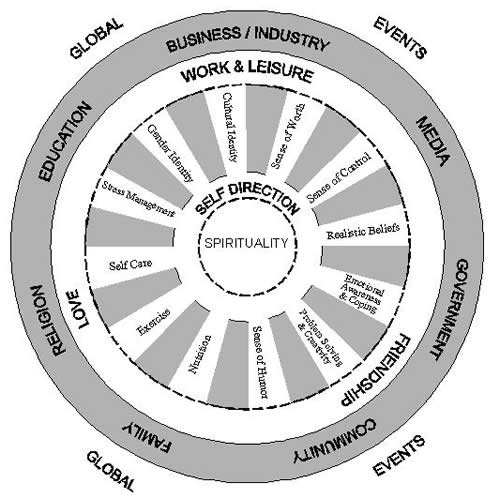
Welcome back to Wellness Wednesday, a fun mid-week look at the areas of wellness in our lives. To remind you, in talking about wellness I'm discussing the positive factors in life that help protect us from the events of life. Wellness is therefore not about the absence of the negative, but the presence of the positive. Remember that I am using the Wheel of Wellness to show the various factors of wellness in our lives.

After introducing the ideas behind work & leisure and looking at an overview of the work factor, today we'll be looking in more detail at the factor of "work" in our lives.

To remind you, here's the definition of the "work" factor of wellness:


Activity that contributes to the well-being of self and others: perception of adequacy of financial resources (financial freedom), job satisfaction, feeling that one’s skills are used, perception of work overload, role conflict, role ambiguity (i.e., psychological job security), participation in decision making (i.e., feeling appreciated), satisfaction with relationships in the job setting


Today I want to look specifically at the phrase "perception of work overload". This is an important issue in our society today, as more and more individuals are being overloaded by work. Here are a few signs and symptoms that you might be headed towards work overload:

  • working increasing hours that are unrealistic or are eating up your time with your family in the evenings
  • unrealistic expectations beyond your job description
  • pressure into working unpaid hours
  • eliminating healthy behaviors from your life in order to work more hours
  • consistently higher and higher levels of stress & frustration
  • Anger
  • Fatigue
  • Dreading going to work
  • Family complaining that you aren't present often, or aren't emotionally present when you're physically present
  • Depression
  • Stomach Pain
  • Migraines
This is obviously a list of only some of the signs and symptoms of work overload, which puts a strain on your body, and will very quickly start decreasing your levels of health and wellness. 

Now it's your turn!
Do you think that you (or someone close to you) have every hit work overload? How does an overload at work influence the other factors of wellness?

Wednesday, February 8, 2012

Wellness Wednesday: {A Review Of Life Task 2}

Welcome back to Wellness Wednesday, a fun mid-week look at the areas of wellness in our lives. To remind you, in talking about wellness I'm discussing the positive factors in life that help protect us from the events of life. Wellness is therefore not about the absence of the negative, but the presence of the positive. I just finished talking about the 2nd (out of 5) life tasks, and I thought this would be a good time for us to review these components.


Life Task 2 is made up of 12 subtasks:

A few questions to get you thinking:
  1. What is your greatest area of strength? 
  2. How does this strength further your overall wellness?
  3. What are your greatest areas of improvement?
  4. What is one step in each of these areas that you can take to help improve those areas? 
  5. How does your overall wellness in nutrition affect your stress management?
  6. What's one new healthy coping skill that you could implement?
It's interesting to think about how the health in one area of our life affects our health in another (either positively or negatively). It's important to regularly evaluate how each of the areas of our wellness is currently impacting us. 

Now it's your turn!
What are your thoughts on wellness in your life? What areas are easier to be healthy in, and what areas are a little more difficult? 

Thursday, January 19, 2012

Playing the Victim Role To Stress

"When we have been prevented from learning how to say no, our bodies end up saying it for us." 
- Dr. Mate

When we put our body into constant stress mode for extended periods of time, we will end up paying a price. Whether it is physically, emotionally, mentally, spiritually, or relationally, it will affect us in some way or another. I think sometimes we get caught in the trap of thinking that we are invincible to stress, and that somehow we can avoid paying the price.

If that's how you think, and it certainly is tempting to think that way because it allows us to not have to change, let me break this to you: YOU WILL end up paying the price, and probably have already in some way.

Today I want to focus on not playing the victim role! I think there's often the temptation to be the victim to stress. After all, events happen to us that we can't control, and we must simply react to what we've been given. This causes stress, doesn't it? Absolutely! However, when we play the victim role to most anything in life, we tend to take the passive approach, and use that thing as an excuse to not do x, y, or z in our life. That thing might make things much more difficult for us, but if we take the passive role, we end up handing our life over to that thing.

And so it is with stress. Many of us have built our own prisons when it comes to stress, and kept ourselves in a passive victim role. We stay locked up in the prisons that we have built by our own choice. We don't always get to choose what happens to us, but we do get to choose how we respond. That means that we can choose if we want to be a victim to stress, or if we want to stand up and try to fight against it. 

It WILL be uncomfortable at times. It will mean living differently then we have in the past. It will mean engaging in healthy stress management. 

Here's my question to you: Are you willing to stand up and play an active role in fighting against stress in your life? Are you willing to say no, set limits appropriately, and take care of yourself? Are you willing to take control of your behaviors? 

I invite you to join me in the journey of fighting against stress, and set up the structure of your life to limit the amount of stress that you experience!

Now it's your turn:
Why is it easy to play the victim role to stress, blaming it for things that happen in life instead of standing up and being responsible for our own behaviors? 

Wednesday, January 18, 2012

Wellness Wednesday: {Stress Management Part 3}

Welcome back to Wellness Wednesday! It might be good to take a moment to refresh your memory about the Wheel of Wellness, and my wellness page includes every past "Wellness Wednesday" post! Remember that wellness isn't the absence of the negative, but the presence of the positive in our lives.
Remember that I'm using the Wheel of Wellness to help visualize health in life:


This will be my last post on the subtask of stress management. You can check out part 1 and part 2 here.
Hopefully you are starting to realize that dealing with stress is crucial to your health, and that while it is definitely difficult to deal with at times, it is worth the time and effort.

Here are a few tips for starting to come up with a plan for stress management in your life:

  • Learn to say no and limit yourself: It's easy to overcommit ourselves. It makes us feel important, it helps us avoid having to deal with "real life problems", or it allows us to continue in our people pleasing. Learning to set boundaries and say no will help limit the number of controllable stressors in your life. We need to learn to say no appropriately, and there are limits to what you can give. You may need to say no to things that are good in life in order to not over spend yourself.  (to learn more about boundaries, click here and scroll down to the "boundaries" heading).
  • Establish a regular practice of deep breathing: Deep Breathing will help control your heart rate, blood pressure, and allow your focus and concentration to increase: all necessary things in controlling our stress! I like to set an alarm for a few times during the day to practice. When you notice yourself starting to get stressed, immediately start deep breathing. 
  • Decrease your unhealthy coping skills, and implement healthy coping skills: Check out this post I wrote on healthy coping. Our unhealthy coping skills, while they seem to work initially, actually create more stress in the long run. Practice and implement healthy coping skills to help effectively decrease your stress. 
  • Don't Use Words Too Big For the Subject: In this post I did on using appropriate language, I talked about the possible detrimental ramifications on using words that are too big for the subject at hand. Watch how you talk to yourself when you're stressed. If you're using words like "horrible", "terrible", "completely overwhelming", "unbearable" or other similar words, you're likely to not only increase your feelings of stress dramatically, but you are less likely to function well in the middle of the situation. Use words that are appropriate for the situation. 
  • Engage in Self Care: In the midst of a crazy schedule and stress, the last thing that seems important is taking time to take care of yourself. Check out this post on self care for ways to take care of yourself!
There are a few easy ways to care for yourself and decrease your stress on a regular basis. Come back tomorrow for a post on not playing the victim role to the stress in our lives! 

Now it's your turn:
What's your favorite way to stand up to stress? Why do we use words that are too big for the subject that we are talking about? How can we feel ok about saying no appropriately! 

Tuesday, January 17, 2012

Our Body's Reaction To Stress

The last few weeks in my Wellness Wednesday posts I've been discussing the subtask of stress management. In case you've missed it, here are the posts in this mini-series:

Wellness Wednesday: {Stress Management Part 1- Healthy Coping}
Wellness Wednesday: {Stress Management Part 2-Eustress}

I thought it might be helpful to explain what actually happens when we get stressed. When we start to feel stressed, our body needs to increase its cardiovascular output in order to bring oxygen and energy to certain muscles. Our body puts out a large amount of stress hormones, which can lead to the following progression:
  • Increased heart rate
  • Increased blood pressure
  • Hypertension
  • Accumulation of plaque on the inner lining of blood vessels, which can lead to heart attacks or cardiac death
  • Neuropsychological changes in affect and behavior
Stress is no joke, but we tend to brush it off, refuse to take the time to deal with it, or even chase after it. During stressful times, our immune system can be negatively impacted because:
  • immune organs shrink
  • disease-fighting cells can be decreased in both number and function
Then there are the changes that we tend to easily recognize when we start feeling stressed:
  • Our appetite can change
    • Some lose their appetite and feel sick
    • Others eat turn to junk food because they crave the simple carbs
    • Either way we aren't giving our body what it needs to function & remain healthy
  • Irritability increases (which can deeply affect relationships)
  • Irrational thoughts become more frequent (leading to increase in anxiety & depressed feelings)
So let me say this again: Stress is no joke! I know it's easy to get into a cycle where we get busy and overwhelmed, and the last thing we think of doing is taking time out of our crazy schedule to cope with the stress in a healthy way. When we're in stress mode, the thought of taking energy to decrease the stress is far from our minds. However, we need to do that which goes against what we naturally want to do: we need to fight the stress and cope with it in healthy ways in order to keep ourselves well both physically and mentally.

Part of the problem is that we get so focused on stress that we sometimes ignore the physical cues that our body sends out, and we find ourselves drowning in stress without realizing it. Here's my challenge to you: Learn the physical cues your body sends out so you can deal with it at the beginning instead of finding yourself drowning in it.

Now it's your turn:
How does your body respond to stress? Does it ever seem like you're too busy to deal with stress? What might the results of this be? 

Wednesday, January 11, 2012

Wellness Wednesday: {Stress Management Part 2- Eustress}

Welcome back to Wellness Wednesday! It might be good to take a moment to refresh your memory about the Wheel of Wellness, and my wellness page includes every past "Wellness Wednesday" post! Remember that wellness isn't the absence of the negative, but the presence of the positive in our lives.


Remember that I'm using the Wheel of Wellness to help visualize health in life:


Today I'm continuing my discussion on the subtask of Stress Management. You can see "part 1" of this subtask here.

I don't think we can have a real discussion on stress management without discussing what "stress" actually means. What IS stress, then? Basically, it's your body's physical and psychological response to anything that you perceive as overwhelming, alarming, or threatening. It's a biological process, with a wide-ranging set of events in the body.

Here's the thing: Not All Stress Is Bad! Sometimes I believe we are trained to think that any and all stress is a bad thing, and we start to panic when we feel stress coming on in our lives. But not all stress is bad, and, in fact, a small amount of stress is actually good for us! Even good stress (i.e. a new job, marriage, or a baby) can become unhealthy and taxing on the body if not properly dealt with.

How is stress good? Here are a few things that stress actually provides for us:

  • initiates invention & problem-solving capabilities and moves us towards creativity
  • It can give us that final push towards making changes or adapting to something
  • It can keep us healthy and happy
  • It pushes us out of our "love affair" with comfort (we can't live within this comfort zone all the time, because we won't change or grow. We become stagnant. Good stress actually helps us be "ok" with getting outside our comfort zone). 
Watch how you react the next time you start feeling a slight amount of stress. Do you panic and freak yourself out? Remember, what we think affects our feelings and our behaviors. The more you say "I'm stressed, I'm so stressed out, I'm overwhelmed", the more you feel overwhelmed and out of control". If you can acknowledge that you are feeling a slight amount of stress and you are choosing to engage with it in a healthy manner, it becomes manageable, and won't take over your life. Does that make sense? 

Here's your challenge: Watch how you talk to yourself when you start feeling stressed? Do you ramp your stress up, or do you acknowledge it for what it is without freaking out?

Now it's your turn:
Do you ramp up your stress level more then it needs to be? How can you use stress for your advantage without letting it overwhelm you?

Wednesday, January 4, 2012

Wellness Wednesday: {Stress Management Part 1- healthy coping}

Welcome to the first Wellness Wednesday post of 2012! It might be good to take a moment to refresh your memory about the Wheel of Wellness, and my wellness page includes every past "Wellness Wednesday" post! Remember that wellness isn't the absence of the negative, but the presence of the positive in our lives.

Remember that I'm using the Wheel of Wellness to help visualize health in life:


Today we will continue discussing Life Task 2 (Self-Direction), and begin discussing the subtask of "Stress Management".

Myers & Sweeney define "Stress Management" the following way:

General perceptions of one’s own self-regulation, seeing change as an opportunity for growth rather than as a threat to one’s security, ongoing self-monitoring and assessment of one’s coping resources, structuring-ability to organize and manage resources (e.g., time, energy, seeing limits, scheduling); need for structure, satisfaction with one’s stress management ability.


Whew! That's quite a mouthful, right? Obviously there's quite a bit involved in stress management, so I'm planning to break this into a few different posts.

Today I'm going to briefly discuss "one's coping resources". A few weeks ago I wrote a post on Healthy Coping Skills that may be helpful for you in determining your own ways of coping. The interesting thing about coping is that it is an activity that can be done before, during, and after the stressful event. Of course this coping will look a little different each time, but it is important to implement this at various stages of stress. Family and Friends play a huge part in healthy coping, as does engagement in faith/religion (social integration is a key in stress management!).

Here are a few questions to ask yourself about how you cope:

  • What things do I naturally go towards to help myself cope with stress (i.e. food, alcohol, TV, music)?
  • Who can I count on in life to help provide coping support when I am stressed and overwhelmed?
  • What aspects of faith and spirituality can help me cope with stressors in my life?
  • What things can I do to cope that are healthy and safe for me?
  • How can I increase my sense of control in this situation to decrease my stress?
  • What things would be helpful to include in my "coping toolbox" so that I'm prepared when stress comes my way?
If you can establish a "coping plan" beforehand, then you'll have something prepared when stress and negative life events happen. Having a plan already created will instantly decrease some of your stress, and will provide you with people, places, and things that will be healthy for you!

Next Wednesday be on the lookout for Part 2 of the "Stress Management" subtask!

Now it's your turn:
What sorts of people, places, and things might be helpful for you to put in your "coping toolbox" so you're prepared for the stressful moments in life? Are there negative ways you cope that you would like to decrease?

Monday, December 19, 2011

Thankfulness Project Monday

"A Christmas candle is a lovely thing; It makes no noise at all. But softly gives itself away; while quite unselfish, it grows small." -Eva K. Logue


Christmas is only a few days away (and Hanukkah starts tomorrow!) , and I'm sure most of you out there are busy prepping for the holiday, traveling, or getting ready to visit family or friends. If you're feeling overwhelmed, take a few deep breaths and check out these tips. And focus on the things that you are thankful for today. Without any further ado, here are a few things I'm feeling thankful for right now:

  • Christmas Outfits: No, I don't wear Christmas sweaters, and certainly don't even own a "tacky Christmas sweater", but I do love holiday themed outfits (red, green, sparkles... you get the picture). It's been fun to see everyone dress in professional Christmasy types clothes over the last few weeks, and makes the day just a little more fun!
  • Christmas Music: Songs like Carol of The Bells or I Heard The Bells On Christmas Day definitely add some extra joy and fun to the Christmas season. I've been listening to Christmas music in the car, in my house, and have instrumental Christmas music playing quietly in the background of my sessions. It's cheery and brings warmth to the room. I love it:)
  • Reading: I don't read nearly as much as I would like to, but when I do get the chance, I really enjoy it. It's fun to learn about new people, cultures, or topics in my field, but it's also fun to lose yourself in a good story! 
  • For the ability to deal with stress appropriately: This is a bit of a different take on the things I'm thankful for, but I'm very glad that we aren't doomed to feeling out of control and I'm glad that we have the ability to control our thoughts, feelings, and behaviors. I'm thankful we have the power to choose healthy coping skills over those that are unhealthy. 
  • For clients who work hard and fight to get healthy: It's so amazing to watch people fight towards health and make changes in their life. I really feel lucky to have such an amazing job! 
Now it's your turn!
What are you feeling thankful for today? What's your favorite Christmas song? 

Tuesday, December 13, 2011

Tips For Reducing Stress During the Holidays {Part 3}

Are any of you starting to feel the pressure and stress of the Holiday Season yet? Christmas can certainly bring out high levels of stress for people, so my goal is to give some easy and practical ways of reducing stress this season. If you've missed the other posts in this series, here are Part 1 and Part 2.

Here are a few other tips for reducing stress:

  • Be practical in the amount of people you buy for: While we may want to get gifts for all those in our lives, sometimes it isn't practical financially or time-wise. Set a limit on the amount of people you are buying for in your life. Your friends will probably more then understanding, or at least relieved it's one less gift they have to buy as well. If you've usually given a gift to someone, and have chosen not to this year, be assertive and tell them that upfront. If you're tight on money, let them know that, while you'd like to buy something for them, you just can't do it this year, but still want them to know that you appreciate your friendship. 
  • Be aware of what your unhealthy coping mechanisms are: Most of us have some unhealthy ways to cope with situations: food, alcohol, picking, etc... Plan in advance what you will do when you are tempted to use these unhealthy coping mechanisms. I find that it can be helpful to create a list in advance of healthy things you can do when you are in a place that you need to cope so it is ready at your fingertips when it is needed. 
  • Be careful to not have unrealistic expectations for family: Sometimes we expect that a family member's behavior will change simply because it's Christmas. Generally speaking, people are who they are no matter what time of the year it is, meaning that just because it's a big holiday doesn't mean the person's behavior will change. 
  • Practice deep breathing regularly: When we start getting stressed, it's easy for us to feel short of breath, our heart races, and our tension shoots up. Practicing deep breathing throughout the day will help keep your stress at bay, allowing you to function as best as possible. Click here to read about developing a deep breathing practice. 
  • Understand that you don't HAVE to get together with family: Sometimes we feel that the holidays obligate us to spend time with family. While it's nice if you can, you are in no way obligated to do this. Perhaps your family is toxic or too inappropriate/dysfunctional/unsafe to be around. You'll have a more enjoyable break if you spend it as an immediately family instead of throwing yourselves into a toxic family situation. 
Well, you now have 15 tips to decrease your overall stress this holiday season. Choose a few to work on and make a priority throughout the next few weeks, and let me know how it goes.

Now it's your turn:
What sorts of stress have you experienced this Christmas season so far? What are 2 tips that you can commit to working on throughout the next few weeks?

Sunday, December 11, 2011

Carol of the Bells

Well, we are firmly into the Christmas season now, and I personally feel that it is rushing by at an incredible speed. Often times on Sunday I post a recap of the week, and I decided to add in a Christmas song that is enjoyable. If you've ever seen this song put to a lights display, it's pretty amazing!

This weekend I've tried to have a mixture of relaxation, exercise, cleaning, and preparing for Christmas vacation. 

In case you missed them, here are some of my posts from the last week:

Remember: now that it is Sunday, it's time to set a few "mini goals" for your health and wellness this upcoming week!

Now it's your turn:
What's one step towards health that you would like to accomplish this week? 

Thursday, December 8, 2011

Tips For Reducing Stress During the Holidays {Part 2}

When we recall Christmas past, we usually find that the simplest things - not the great occasions - give off the greatest glow of happiness.  ~Bob Hope

A few days ago I posted part 1 of the series on reducing stress during the holidays. If you missed it, you can check it out here.

Obviously there are a LOT of different things you can do to reduce stress, so here are 5 more tips for reducing stress:

  • Focus on the "little joys": It's easy to get caught up in the big things of the Christmas season. However, it's often the little or simple things that we remember (see the quote above). When I think of Christmas, it's not the big activities that I think about (they may be "big", but that can lead to more stress too), but the little things: drinking hot chocolate by the fire, watching cheesy Christmas movies, or sleeping next to the Christmas tree with my brothers. None of these are great occasions, but they are the things I ache for all year round and look forward to anxiously as Christmas approaches. 
  • PLAN! (yet be flexible): Plan our your menus & go shopping ahead of time. There's a lot of food that you can purchase a week or two in advance, which will be helpful in avoiding large lines. This will also (hopefully) ensure that you don't forget something essential along the way. 
  • Be Flexible in Creating New Traditions: Ok, I have to admit: this was really hard for me to type  and i'm having a slight panic attack just thinking about it. Seriously, I'm a big "traditions" girl, so I know how tough it can be to be flexible in letting go of, or starting, a tradition. However, because families and friends are always changing, flexibility in this area is important in order to reduce stress (and stay HAPPY throughout the holiday season). Take a deep breath, engage in positive self talk, and tell yourself that you are ok. It is also fine to tell those around you that it is stressful for you to try a new tradition, but that you are trying hard to enjoy it. Acknowledging how you are feeling is fine!
  • Ask For Help! Maybe holidays bring out a nasty side of family members, and you need help from a counselor to learn how to best deal with this. OR, maybe it's help in preparing for a party. Remember that we aren't meant to do life alone, and social support is crucial for a healthy life. Ask your friends, family, or a professional for help if you need it!
  • Continue to practice gratitude and thankfulness: I wrote an entire post on this practice, and you can check it out here. Regularly practicing this can lower blood pressure and make you less hostile, which is definitely important during the holiday season! 
*This post is part of a series on various aspects of health during the holidays. Make sure to stay tuned for more posts on this subject.

Now it's your turn:
How do you deal with stress in any of the areas above? Do you struggle to feel "ok" when traditions change, or are you more of a "go with the flow" person? 

Tuesday, December 6, 2011

Tips For Reducing Stress During the Holidays {Part 1}

Oh, for the good old days when people would stop Christmas shopping when they ran out of money.  ~Author Unknown

Last year I did a post on Tip for Surviving the Holidays with Family. I think many of these tips are applicable in each of your lives (unless your family is, in fact, perfect!), so make sure to check them out!

Stress levels can easily sky-rocket during the holiday season, which can place further distress on our relationships. Today I want to pass along a few tips for reducing stress during the holidays.
  • Prioritize Your Activities! There are so many great activities this time of year in which to participate. Christmas movies, Christmas concerts, parties, gift exchanges, caroling, cooking decorating parties: you name it, it exists and you've probably been invited to it. You can't do everything, so prioritize and say "no" to those activities that don't make the cut. For the people pleaser, this is difficult, but remember that YOUR HEALTH is important (if you are a people pleaser, click here and scroll down to the "boundaries" category).
  • Make Sure To Take Your "Me" Time: While this is a good season to look outside ourselves, give to others, and celebrate with one another, it's important to get a few minutes every day for self care. The ability to recharge ourselves helps create a buffer against holiday stress, and increases our patience towards those around us. 
  • Maintain healthy habits: During holidays it's easy to give up exercise, healthy eating, and sleep. Doing that will certainly make you feel worse both physically and emotionally. Make sure to continue your healthy habits as much as possible, and remember that balance is important!
  • Set a budget for yourself: Our stress can increase if we dig ourselves into a financial mess. Be wise with your spending, and make sure you are careful on how you spend. If you are lonely or feeling "low" emotionally, there can be a temptation to buy "stuff" in order to cope. It might help in the moment, but will not actually help the situation, and put you in a bigger mess when it comes time to pay the bills. This can be a HUGE stressor for months following Christmas, so make this "tip" a priority. (This is also why I started this post with the quote above).
  • Release the expectation of a "perfect" holiday: Most of us imagine the holiday in a certain way. Even if it isn't "perfect", this imagination tends to become our expectation of what the holiday will be. To be healthy, it is important to let go of expectations for the "perfect" meal, the "perfect" gifts for families, the "perfect" decorations for the house, etc... Do your best, but don't kill yourself over trying to make everything about the holiday perfect. You (or your children) will more then likely remember how stressful it was over how fun it was. 
*Part 2 of this post will be coming later this week!

Now it's your turn:
How do you work on reducing the stress in any of the areas listed above? 

Friday, October 7, 2011

Friday Favorites

Favorite Tiny Delight of the Week:
Greek Food. I love it and could eat it every meal and be OK with it. I was in Greece once for a month and felt so sad when I left and didn't have easy access to it anymore. This weekend I made a various of this souvlaki salad and every bite of it was delicious! I love the extra challenge and fun that various cultures provide in terms of food, and it's my goal to add as much variety of these foods and cultures into my life!

Favorite Quote of the Week:

“Balance is not better time management, but better boundary management.  Balance means making choices and enjoying those choices.”   – Betsy Jacobson


Favorite Post by Someone Else:
Are You An Addict by Emily at Perfection Isn't Happy - This post is a great look into working out and exercise as a balance in life, and the process of it becoming an addiction. Working out is healthy, but being addicted to it is not. I loved some of the thoughts she had on the issue!

Favorite search terms:
Now it's your turn!
What are some of your "favorites" for the week? What are your thoughts on exercise addiction? What does balance mean to you?

Thursday, September 1, 2011

Advice For College Students

The purpose of primary education is the development of your weak characteristics; the purpose of university education, the development of your strong.  ~Nevin Fenneman

An investment in knowledge always pays the best interest.  ~Author unknown, commonly attributed to Benjamin Franklin

Whether you think you can or think you can't - you are right.  ~Henry Ford

As fall is ushered in every year, hundreds of thousands of students pack up and move back into colleges across the world. Without an intentional focus on what you're doing and what you want out of college, it's easy to waste it. That being said, I thought I'd ask some of my blog readers and twitter followers what advice they would give themselves as a college freshman. Here's what a few of them said:
And here are a few others I have based off my own life and my years working at a college:

  • Create a mission statement for college and post it on your desk. There are days you'll wonder if it's worth all the work, pain, and sacrifice, and it'll be helpful to have something concrete to go back to.
  • Create a balance between work and play: Sometimes it's easy to get caught up on all the parties and events that colleges have to party. Don't seclude yourself, but you also don't have to attend everything out there. Remember that you are at college to get an education, and you're paying a lot for it. Don't waste it.
  • Learn to say "no": There are so many good opportunities at college: clubs, volunteer work, jobs, friendships, and classes. You can't do it all, and if you don't learn to say no, you'll end up being stressed and burned out. Choose a handful of things that are important, and say no to the rest. 
  • Don't Skip Class: It's REALLY tempting to skip class in order to sleep, go to a party, or watch TV. Don't do it. Professors tend to have a lot more grace with you if you have an emergency or need an extension if they see that you're putting forth an effort to show up. 
  • Study Abroad! If you have a chance, travel as much as you can! You learn a lot about yourself and the world by doing it!
  • Get to Know Yourself: College is the time where you step away from your parents and have control of the choices you make in life! Get to know who you are, and feel confident in that! Develop self worth. Learn what your strengths are and then develop them! Learn how to cope with your weaknesses.
  • Increase Health And Wellness: There are a huge amount of jokes out there about the lack of health in college. Remember that every day you have the choice about what healthy decisions you make! Try adding different wellness behaviors to your life!
  • Develop Coping Strategies for stress and anxiety: Those stressful moments will come up. If you healthy coping skills in place for those moments so that they don't suck you under. 

Obviously there's a number of other things I could say about starting college, but long lists get overwhelming:) 

Now it's your turn:
What was the most important lesson you learned in college? What's your best piece of advice?

Wednesday, August 31, 2011

Wellness Wednesday: {Problem Solving & Creativity}

Trust that little voice in your head that says "Wouldn't it be interesting if..."  And then do it.  ~Duane Michals, "More Joy of Photography"

To think creatively, we must be able to look afresh at what we normally take for granted.  ~George Kneller


Welcome to another Wellness Wednesday post! I can't believe how many weeks this weekly post has occurred. If you've missed some of the previous posts, click here to check them out!


Today I'll continue to work my way through Life Task 2, discussing Problem Solving & Creativity.


Myers & Sweeney describe this factor of wellness the following way:


Being mentally active, open minded, ability and desire to be creative, curiosity, need to know, need to learn, capacity to collect data, analyze, synthesize, choose and evaluate consequences of outcomes (i.e. divergent and convergent thinking), capacity to change one’s thinking to manage stress (cognitive restructuring), capacity to apply the above characteristics in resolving social conflict.


Problem Solving & Creativity, which involves intellectual stimulation, can help increase neural connections, leading to greater brain plasticity later in life. Myers and Sweeney (2005)* state that this component is “necessary for healthy brain functioning and hence quality of life across the life span” (p. 23). This component is not only necessary to increase everyday functioning, both at work and in our personal life, but is also necessary for physical health in the later years of our life. 


I have to be honest. I have always wished that I was a more creative and artistic person. When I first started researching the components of wellness, I realized that I am creative! Meeting with clients takes a lot of problem solving and creativity skills, from helping guide them to change, realizations & self awareness in life, and creating treatment plans for them. It's not what we typically think of in terms of creativity, but it is using the brain in a creative fashion. This is also a crucial component in learning to deal with stress. Unless we can identify the causes of the stress, what things trigger us, and what situations these things occur in, and then learn to implement appropriate coping skills, we will be stuck in a pattern of unhealthy behaviors. Problem solving is important to learning to deal with and conquer the stress in our lives.


When we learn to apply a set of criteria to a situation to solve a problem, we build neural connections, as well as confidence in self in the future. 
When I go about trying to solve a problem, here are some of the steps I take:

  1. What problem are you trying to solve? Define your terms and create a question to answer.
  2. Categorize problems from urgent to less urgent.
  3. Collect as much information as I can about the situation: Talk to multiple parties, get expert advice, learn from the mistakes of others, and do as much research as possible. It's easy to make a decision without being informed, which can lead to problems.
  4. Evaluate the information and put it into a few general categories or ways to solve the problem.
  5. Rate each category on a scale of 1-10. If you want to make a pro-con list for each, and then rate each item for each category, this will give you even more information.
  6. Decide on a plan to best implement your solution to the problem.
  7. Action! Put the plan into action and follow up with evaluation to determine if the problem has actually been solved.
Of course I don't take each of these steps with every problem- some situations require more steps, while some require much less. 

Here are a few questions to ask yourself for this category:
  1. When you stumble across a problem, do you think through various options or jump to a conclusion without thinking?
  2. Do you do activities to increase problem solving skills (i.e. sudoku or logic problems)?
  3. How do you currently experience creativity in your every day life?
  4. What can you do to increase creative experiences in your life?
  5. What is your approach when you hit a problem and need to come to a solution?
  6. When feeling stressed, are you able to identify the stressor and implement appropriate steps to decrease the stress?
Here's what I'd like to know:
How do you experience creativity in your everyday life? What can you do to increase your problem solving skills?


*Myers, J.E., & Sweeney, T.J. (2005). Counseling for wellness. Alexandria, VA: American Counseling Association. 

Monday, July 25, 2011

Wellness Wednesday: {Life Task 2: Self Direction}

Welcome back to Wellness Wednesday! If you haven't read the rest of the series, you can catch up on the posts here:
Wellness Wednesday: {An Introduction}
Wellness Wednesday: {An Introduction pt. 2}
Wellness Wednesday: {The Wheel of Wellness Part 1}
Wellness Wednesday: {The Wheel of Wellness Part 2}
Wellness Wednesday: {Life Task 1: Spirituality}


For those of you who have read some of the posts, you might recall that I'm using the idea of the Wheel of Wellness to visually represent wellness for the individual.


Last week I discussed the first Life Task, Spirituality. Today I'll start with the 2nd Life Task: Self Direction.

Myers, Sweeney, & Witmer define Self Direction the following way:
"The process by which one directs, controls, manages the self in ways that are self-enhancing, within societal norms, through the following 12 subtasks". 

If you click on the picture above, you can find the 12 subtasks in the spokes of the wheel. These life tasks are about how you are living within the world, and includes things like realistic beliefs, stress management, emotional awareness and coping, and self care. I find that a few of these subtasks are often overlooked when it comes to defining wellness, and that is part of the reason why I love the concept of this Wheel. 

These 12 life tasks are positive, healthy traits of an individual that help lead to a decrease in stress and an increase in the resiliency of that person. Resiliency, of course, is important in helping an individual survive and come back from a difficulty in life. 

I'll be talking through the next 12 subtasks individually, so I don't want to go into too much detail in this post. 

A few things to think about:
1. What's one of the most surprising of the 12 subtasks under self direction?
2. Rank the order you believe for yourself from healthiest to least healthy. Is this ranking surprising to you?
3. How do you think your health (or lack there of) in one of these subtasks changes the wellness level of the other subtasks?