Showing posts with label Deep Breathing. Show all posts

Wednesday, January 18, 2012

Wellness Wednesday: {Stress Management Part 3}

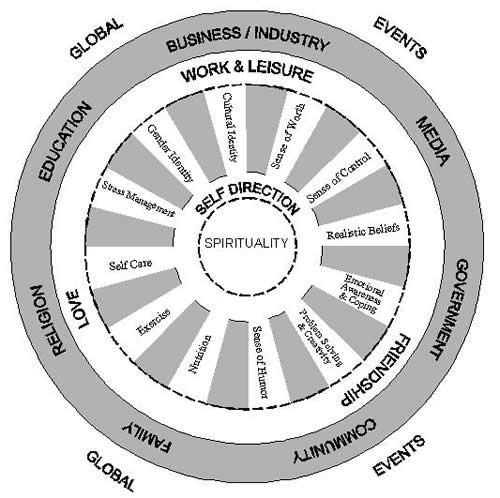
Welcome back to Wellness Wednesday! It might be good to take a moment to refresh your memory about the Wheel of Wellness, and my wellness page includes every past "Wellness Wednesday" post! Remember that wellness isn't the absence of the negative, but the presence of the positive in our lives.
Remember that I'm using the Wheel of Wellness to help visualize health in life:


This will be my last post on the subtask of stress management. You can check out part 1 and part 2 here.
Hopefully you are starting to realize that dealing with stress is crucial to your health, and that while it is definitely difficult to deal with at times, it is worth the time and effort.

Here are a few tips for starting to come up with a plan for stress management in your life:

  • Learn to say no and limit yourself: It's easy to overcommit ourselves. It makes us feel important, it helps us avoid having to deal with "real life problems", or it allows us to continue in our people pleasing. Learning to set boundaries and say no will help limit the number of controllable stressors in your life. We need to learn to say no appropriately, and there are limits to what you can give. You may need to say no to things that are good in life in order to not over spend yourself.  (to learn more about boundaries, click here and scroll down to the "boundaries" heading).
  • Establish a regular practice of deep breathing: Deep Breathing will help control your heart rate, blood pressure, and allow your focus and concentration to increase: all necessary things in controlling our stress! I like to set an alarm for a few times during the day to practice. When you notice yourself starting to get stressed, immediately start deep breathing. 
  • Decrease your unhealthy coping skills, and implement healthy coping skills: Check out this post I wrote on healthy coping. Our unhealthy coping skills, while they seem to work initially, actually create more stress in the long run. Practice and implement healthy coping skills to help effectively decrease your stress. 
  • Don't Use Words Too Big For the Subject: In this post I did on using appropriate language, I talked about the possible detrimental ramifications on using words that are too big for the subject at hand. Watch how you talk to yourself when you're stressed. If you're using words like "horrible", "terrible", "completely overwhelming", "unbearable" or other similar words, you're likely to not only increase your feelings of stress dramatically, but you are less likely to function well in the middle of the situation. Use words that are appropriate for the situation. 
  • Engage in Self Care: In the midst of a crazy schedule and stress, the last thing that seems important is taking time to take care of yourself. Check out this post on self care for ways to take care of yourself!
There are a few easy ways to care for yourself and decrease your stress on a regular basis. Come back tomorrow for a post on not playing the victim role to the stress in our lives! 

Now it's your turn:
What's your favorite way to stand up to stress? Why do we use words that are too big for the subject that we are talking about? How can we feel ok about saying no appropriately! 

Thursday, December 15, 2011

Healthy Coping Skills

"Coping refers to the thoughts and actions we use to deal with stress. In large part, feeling stressed or not depends on whether we believe we have the coping resources to deal with the challenges facing us. Most coping strategies fall into one of two broad categories:
  • Problem-focused coping strategies are used to tackle the problem directly. 
  • Emotion-focused coping strategies are used to handle feelings of distress, rather than the actual problem. 
In general, research has shown that problem-focused coping strategies are the most effective way for dealing with stress" (the above information is from this website). 

In this post I mentioned that it is beneficial to understand what our unhealthy coping mechanisms are in life (food, alcohol/substances, etc...), and learn to replace those with healthy coping mechanisms or skills. in coping we want to deal with the physical problems that are occurring, and we also want to address the emotions that go along with that situation. Given that this time of the year can be incredibly stressful (and because someone requested it!), here are a few healthy coping skills to practice and implement in your life. 

  • Attempt to increase your sense of control: In this post I discussed ways to increase or develop your sense of control in life. Implementing organizational strategies and setting small goals for yourself will help to increase your sense of control as well. (Food is NOT a healthy way to try to gain control, and can lead to an eating disorder)
  • Positive Reappraisal: This is simply what is sounds like it is. This process involves trying to view the positive within the situation in which you find yourself. This is about identifying the positive things that are happening instead of repeating the soundtrack of negative things that we find ourselves replaying. 
  • Addressing Cognitive Distortions: Challenge & Change the Irrational Beliefs that you might be holding on to. Any of the posts listed here under "Cognitive Distortions" will be helpful in addressing this. 
  • Writing: What goes on in our heads can sometimes be a jumbled mess, like someone took a handful of bouncy balls and let them go in our heads. If we can get all the stuff in our heads out onto paper (even the computer screen is better then nothing), we can sometimes develop a different perspective on the situation, or feel as if it is not so chaotic. This allows us to process the situation in a different way then simply by stressing out about it in our heads. Spend 10-15 minutes writing about the situation (or doing a free-write/stream of consciousness) and see what happens. 
  • Engage in Deep Breathing: Check out this post for steps to develop a practice of deep breathing. This will help to bring your heart rate and blood pressure down, and help you focus on the situation at hand. 
  • Exercise: But keep it balanced and moderate. Too much exercise can become unhealthy, just as no exercise is unhealthy. Engage in yoga, pilates, running, swimming, spinning, or some other form of exercise that will help combat some of the emotions you are experiencing. 
  • Engage in a hobby or activity you enjoy: Take a few minutes to take a long bath, watch a funny TV show, talk to a friend on the phone, write a letter to someone, play with pets, or volunteer. Here are a few other tips to refill yourself
  • Engage in or practice spiritual or religious activities: Spiritual communities can be a source of a great amount of support and encouragement. Some people find reading scriptures, prayer, or other similar activities to be encouraging. 
Ok, this is getting a bit long, so I will end my list of coping strategies at this point. The most important are to figure out ways that are helpful for you in various situations, and then practice these regularly. 

Now it's your turn:
What is one healthy coping skill you can commit to trying out and practicing in your life? 

Tuesday, December 13, 2011

Tips For Reducing Stress During the Holidays {Part 3}

Are any of you starting to feel the pressure and stress of the Holiday Season yet? Christmas can certainly bring out high levels of stress for people, so my goal is to give some easy and practical ways of reducing stress this season. If you've missed the other posts in this series, here are Part 1 and Part 2.

Here are a few other tips for reducing stress:

  • Be practical in the amount of people you buy for: While we may want to get gifts for all those in our lives, sometimes it isn't practical financially or time-wise. Set a limit on the amount of people you are buying for in your life. Your friends will probably more then understanding, or at least relieved it's one less gift they have to buy as well. If you've usually given a gift to someone, and have chosen not to this year, be assertive and tell them that upfront. If you're tight on money, let them know that, while you'd like to buy something for them, you just can't do it this year, but still want them to know that you appreciate your friendship. 
  • Be aware of what your unhealthy coping mechanisms are: Most of us have some unhealthy ways to cope with situations: food, alcohol, picking, etc... Plan in advance what you will do when you are tempted to use these unhealthy coping mechanisms. I find that it can be helpful to create a list in advance of healthy things you can do when you are in a place that you need to cope so it is ready at your fingertips when it is needed. 
  • Be careful to not have unrealistic expectations for family: Sometimes we expect that a family member's behavior will change simply because it's Christmas. Generally speaking, people are who they are no matter what time of the year it is, meaning that just because it's a big holiday doesn't mean the person's behavior will change. 
  • Practice deep breathing regularly: When we start getting stressed, it's easy for us to feel short of breath, our heart races, and our tension shoots up. Practicing deep breathing throughout the day will help keep your stress at bay, allowing you to function as best as possible. Click here to read about developing a deep breathing practice. 
  • Understand that you don't HAVE to get together with family: Sometimes we feel that the holidays obligate us to spend time with family. While it's nice if you can, you are in no way obligated to do this. Perhaps your family is toxic or too inappropriate/dysfunctional/unsafe to be around. You'll have a more enjoyable break if you spend it as an immediately family instead of throwing yourselves into a toxic family situation. 
Well, you now have 15 tips to decrease your overall stress this holiday season. Choose a few to work on and make a priority throughout the next few weeks, and let me know how it goes.

Now it's your turn:
What sorts of stress have you experienced this Christmas season so far? What are 2 tips that you can commit to working on throughout the next few weeks?

Thursday, March 3, 2011

10 Ideas to Refill Yourself {I can't give what I don't have pt 2}

In yesterday's post I introduced the idea that "I can't give what I don't have." Unless I'm healthy and taking care of myself, I will very quickly not have much to give to my clients. So this begs the question, "how do I take care of and refill myself"?
Of course I'd love to say that I can afford to get my nails done every week, and go to the spa each weekend (I think I'd definitely feel relaxed if I could do that!). However, I can't afford that, but that doesn't mean that I can't still take care of myself.

Here are a few of my tips and ideas for refilling myself:


1. Limit my number of one way/helping relationships: I give all day at work to my clients, and obviously it isn't appropriate for them to refill me. Because I'm giving all day, I need to have two way relationships with others after work, where there is a mutual give and take. It's fine to give of yourself, but you need to be able to receive as well.
2. Unplug! It's tempting to be constantly checking emails, texts, twitter/facebook updates, etc...but it's not a mental break. One of my rules is that I don't check my work email when I'm at home at night. And I'll check it at most one time over the weekend. Nothing is an absolute emergency that can't wait until the next morning.
3. MOVE. Whether you turn on music and dance in your living room, go on a walk with a friend, go on a run, or some other form of physical activity, it is important for your mental & physical health! This will help to decrease some of the stress and tension that easily builds up!
4. Enjoy Nature. Find the beauty in nature, capture it in a photography, or mix nature and moving together.
5. Keep a Thankfulness Journal. Remember my post on the Thankfulness Project? This can help to increase mood and to refocus on the positive.
6. Incorporate Deep Breathing. Establish a regular practice of deep breathing in your life. This helps slow down heart rate, decrease stress hormones, and increase focus and concentration. Whether you are sitting in a meeting, cooking dinner, or having a conversation with a friend, you can engage in this process!
7. Take a Bath
8. Read a Book For Fun
9. LAUGH. Remember that Sense of Humor is one of the 17 components of wellness. Spend a few minutes laughing every day.
10. Learn to say no! There will always be more good things to be involved in then there is time. Learn to say no so you don't overcommit yourself or stretch yourself too thin. Engage in a few things wholeheartedly instead of giving half-heartedly to many things.


Those are a few of the things that I have found to be helpful in giving to myself so that I can keep giving to others. Let me say this: It can be incredibly hard to do this, so in no way am I suggesting this is always simple to do. However, to be healthy you MUST take care of yourself!

What activities do you do to refill yourself? 

Wednesday, January 19, 2011

Bronchitis (my current BFF)

I've been home sick from work the last 3 days with a fever reaching 103.5 degrees & bronchitis. I don't think anything has knocked me down from work this long except for influenza. You'd think that I could muster some strength for a creative post about Ecuador (don't worry...it's coming!), but for now, this is a post dedicated to Bronchitis (it's on my mind a little bit!). I know a number of friends around the country have also been diagnosed with bronchitis, so I thought I'd post the signs and symptoms for bronchitis. Knowing symptoms can help you seek treatment faster, and hopefully catch it before it sets in too deeply. The following is from the Mayo Clinic Website


For either acute bronchitis or chronic bronchitis, signs and symptoms may include:
  • Cough
  • Production of mucus (sputum), either clear or white or yellowish-gray or green in color
  • Shortness of breath, made worse by mild exertion
  • Wheezing
  • Fatigue
  • Slight fever and chills
  • Chest discomfort
If you have acute bronchitis, you may have a nagging cough that lingers for several weeks after the bronchitis resolves. However, bronchitis symptoms can be deceptive. You don't always produce sputum when you have bronchitis, and children often swallow coughed-up material, so parents may not know there's a secondary infection. You can develop chronic bronchitis without first developing acute bronchitis. And many smokers have to clear their throats every morning when they get up, which, if it continues for more than three months, may be chronic bronchitis.
Treatment includes:
The goal of treatment for bronchitis is to relieve symptoms and ease breathing. Sometimes, all you may need to recover from acute bronchitis may be:
  • Rest
  • Drinking fluids
  • Breathing in warm, moist air
  • Taking an over-the-counter (OTC) cough suppressant and acetaminophen (Tylenol, others) or aspirin (for adults)
Here are a few things I've found that have helped me:
1. Lots of hot tea with honey. This has helped to break up blockage in the throat, decreasing coughing and helping with ease of breathing.
2. "Steaming"- My mom did this with me while growing up. Fill a sink with hot water, and hang your head over the sink with a towel over your head to trap in the heat.
3. Deep Breathing to help decrease the chance of Pneumonia
4. SLEEP! I have a desire to push myself, force myself to clean, organize, or go to work. But I've forced myself to rest and sleep all day
5. Nasal Lavage- This helps to clear out my sinuses and decrease the passage
6. Cough into your elbow or sleeve. DO NOT COUGH INTO YOUR HANDS, because this will spread to others... 

Sunday, January 2, 2011

Using Time Wisely

Happy New Year! I hope you all had a great Christmas break filled with fun, laughter, family & friends, and healthy choices! I spent New Years weekend with some friends from college, and had a wonderful time. It's hard to be back to real life, bills, dishes, and work.

Today while I was waiting in line to check out at the grocery store, I picked up the latest issue of Real Simple Magazine. They had an article discussing the idea "If you have just five minutes, do...". Interesting. One thing I see in my life and in the lives of those around me is black and white thinking when it comes to using our "down time." We have all sorts of little five and ten minute sections of time throughout the day, and we tend to use it on facebook, playing a game on the computer, or turning on the TV. Then, at the end of the day, we have a pile of chores and responsibilities on our To-Do list. So, what if we could change our thinking about those little 5 minute chunks of time? What if we began to use those little chunks so that we could be more efficient, or have a chunk of time at the end of the night to truly relax? Wouldn't we be less stressed, happier, and more relaxed people?

So here are some of my suggestions of how to use little 5 and 10 minute chunks of time:

1. Do the dishes
2. Clean the sink
3. Dust a room in the house
4. Respond to a few important emails
5. Do deep breathing to increase relaxation
6. Write a quick note of encouragement or appreciation to a friend
7. Re organize a drawer or shelf in your house
8. Throw out any trash that has collected in your car
9. Look up a recipe for dinner
10. Write out a few bills for the month
11. Fold a load of laundry
12. Order some prints of your digital photos
13. Do jumping jacks, planks, crunches, or another short burst of activity
14. Fill up the car with gas and wash the windows
15. Clean out a shelf of your refrigerator
16. Clean your toilet bowls or tub/shower
17. Reorganize your document or picture folders on your computer
18. Return a phone call
19. Make the bed
20. Put DVDs or CDs back in their correct cases

So there's 20 things I do in my little chunks of down time. Remember, you don't have to clean the bathroom or kitchen all at once. It's OK to split up chores like that over the course of an evening or a day. Or even two days:) Don't lock yourself into rules that create time wasters instead of using time well. And your reward: extra sleep or down time at the end of the evening!

Any other thoughts or suggestions? Feel free to leave a comment or tweet me!

Monday, November 8, 2010

Deep Breathing for a Healthy Life!


No matter what my clients are coming in for, I teach almost all of them the art of deep breathing. What...being taught how to breathe? I know, it sounds stupid. We've all been breathing longer then almost anything else we've done in life. However, very few of us breathe properly. I always say that this is one of the most healthy things you can do for yourself in the shortest amount of time. Throughout our daily lives we all experience stress. By using the deep breathing technique, we evoke a relaxation response within us, reducing tension, the level of stress hormones in our body, and increasing oxygen throughout our body.

So, here's how to do it.Find a quiet, non-stressful environment. Sit up straight, but relaxed. Close your eyes and place a hand on your stomach and a hand on your chest.
Normally when you breathe your shoulders move up and down. THIS IS INCORRECT. Your stomach should move in and out if you are breathing properly. As you breathe in slowly through your nose, your stomach should push out, as you exhale, your stomach should go back in (toward the direction of your backbone). Your hand should move out as you breathe in, and in as you breathe out. Breathe in through your nose, out through your mouth. Do each for a count of 8-10 seconds.
Remember in elementary school when you were learning basic addition, multiplication, etc... and you had to do those awful time tests? By doing them over and over again, it became so natural that most of us don't even need to think when adding 2+3 or 5+5 now. That's what practicing the art of deep breathing is. We need to practice it each day for it to become natural so we can use it in times of stress.
This is something you can do while sitting in class, in a meeting, at work, or when frustrated at your significant other, parents, or children.
Like I said, this is one of the most important things you could do for your health! And remember, in life we don't always get to choose what happens to us. We WILL encounter stress. But when we encounter those times, we get to choose how we respond, and deep breathing is a great way to choose a positive way to respond! 
Try setting a short among of time each day (5 minutes or so), or twice a day, to practice deep breathing.