Showing posts with label thoughts. Show all posts

Wednesday, February 8, 2012

Wellness Wednesday: {A Review Of Life Task 2}

Welcome back to Wellness Wednesday, a fun mid-week look at the areas of wellness in our lives. To remind you, in talking about wellness I'm discussing the positive factors in life that help protect us from the events of life. Wellness is therefore not about the absence of the negative, but the presence of the positive. I just finished talking about the 2nd (out of 5) life tasks, and I thought this would be a good time for us to review these components.


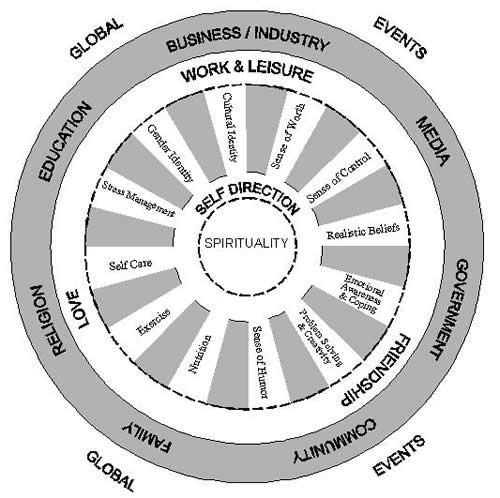
Life Task 2 is made up of 12 subtasks:

A few questions to get you thinking:
  1. What is your greatest area of strength? 
  2. How does this strength further your overall wellness?
  3. What are your greatest areas of improvement?
  4. What is one step in each of these areas that you can take to help improve those areas? 
  5. How does your overall wellness in nutrition affect your stress management?
  6. What's one new healthy coping skill that you could implement?
It's interesting to think about how the health in one area of our life affects our health in another (either positively or negatively). It's important to regularly evaluate how each of the areas of our wellness is currently impacting us. 

Now it's your turn!
What are your thoughts on wellness in your life? What areas are easier to be healthy in, and what areas are a little more difficult? 

Thursday, February 2, 2012

Treatments For Seasonal Affective Disorder

Continuing on with my discussion on Seasonal Affective Disorder, today I'll be talking about how to treat it. There are a number of ways to treat seasonal affective disorder. Like traditional depression, a combination of medication and therapy may be incredibly helpful.
In regards to therapy, the following steps will likely be discussed:

Another step that can be taken to help treat Seasonal Affective Disorder is the use of light therapy (also known as phototherapy). In this type of therapy "you sit a few feet from a specialized light therapy box so that you're exposed to bright light. Light therapy mimics outdoor light and appears to cause a change in brain chemicals linked to mood" (source). An important side note- the light therapy, while helpful, can increase symptoms for those who have bipolar disorder. Please talk to your doctor before purchasing a box!

In the morning while getting ready, eating breakfast, or reading, you can turn on the light and let it hit your eyes. This will mimic the sun and not only help wake you up in the morning, but will help change the levels of chemicals and hormones in your body that will regulate mood, among other things! Some insurance companies will help cover the costs of this, so talk to your doctor! For anyone living in a place with little sunlight in the winter, this can be a great asset to overall health and a feeling of wellness in life! 

As with depression, there are other lifestyle and environmental changes you can make to help aid in treating this disorder. Keep blinds open to allow for light (even if it isn't sunny outside) to fill your house. Get out and move. With depression that's generally one of the last things you want to do, but getting outside and moving can greatly help overall mood. Surrounding yourself with good social supports and not isolating is also incredibly important. 


Now it's your turn:
Have you ever heard of light therapy before? What steps do you take in the winter to keep your mood up? 

Wednesday, February 1, 2012

Wellness Wednesday: {Cultural Identity}

Welcome back to Wellness Wednesday! For more information on the Wheel of Wellness, you can check out my wellness page, which includes every past "Wellness Wednesday" post! Remember that wellness isn't the absence of the negative, but the presence of the positive in our lives.
Remember that I'm using the Wheel of Wellness to help visualize health in life:


Alright, after today's post we'll have finally made it through all of Life Task 2 of the Wheel of Wellness. So, today we move on to the final subtask of Life Task 2: Cultural Identity!

Myers & Sweeney define this subtask the following way:

Satisfaction with one’s cultural identity, feeling supported in one’s culture, valuing relationships with people of many cultures, transcendence of cultural identity, competency to cope with stress of cultural identity


When most people start listing dimensions of wellness, this is not one that is often mentioned. However, I think it's an important component of wellness, and once again I'm happy that Myers & Sweeney have included this in the dimensions of Wellness. Myers & Sweeney say the following about cultural identity: "cultural identity incorporates racial identity, acculturation, and an appreciation for the unique aspects of one's culture and is positively related to well-being. It is a positive personal strength that enhances growth and development across the life span" (Myers & Sweeney, 2005, p. 25). Of course our views on most things in life are in some way influenced by our culture as well.

For many Caucasians, it can feel like we don't have a culture, or at least culture the way that some other groups of people experience culture. For those of you who feel that way, here's an idea of how to connect with culture:

  • Determine what countries your ancestors come from. Do a bit of research to figure out what the beliefs, habits, and holidays of those cultures are.
  • Match these values, beliefs, or habits with your own life to see what has trickled down from these cultures. 
  • Is there a way that you can incorporate your country of origin's celebrations into your life here? This can help you gain an appreciation of other cultures, all while gaining knowledge and having fun! 
Once you go looking for it, it's interesting how many things we do that come from other cultures. 

And a few questions to get you thinking:
  1. Are there things you can do to learn more about other cultures and gain an appreciation of them?
  2. How can you increase your knowledge of your own culture?
  3. What can you do to interact with people from other cultures? How can you "get outside yourself"? 
  4. Have you ever felt unappreciated or discriminated against because of your culture?
  5. If you experience stress due to your cultural identity, what steps can you take to keep yourself healthy? 
Now it's your turn:
Do you feel you have a culture? How can you increase your appreciation of both your own culture and of the cultures around you?

* Myers & Sweeney. Counseling For Wellness: Theory, Research, and Practice. (2005). 

Wednesday, January 18, 2012

Wellness Wednesday: {Stress Management Part 3}

Welcome back to Wellness Wednesday! It might be good to take a moment to refresh your memory about the Wheel of Wellness, and my wellness page includes every past "Wellness Wednesday" post! Remember that wellness isn't the absence of the negative, but the presence of the positive in our lives.
Remember that I'm using the Wheel of Wellness to help visualize health in life:


This will be my last post on the subtask of stress management. You can check out part 1 and part 2 here.
Hopefully you are starting to realize that dealing with stress is crucial to your health, and that while it is definitely difficult to deal with at times, it is worth the time and effort.

Here are a few tips for starting to come up with a plan for stress management in your life:

  • Learn to say no and limit yourself: It's easy to overcommit ourselves. It makes us feel important, it helps us avoid having to deal with "real life problems", or it allows us to continue in our people pleasing. Learning to set boundaries and say no will help limit the number of controllable stressors in your life. We need to learn to say no appropriately, and there are limits to what you can give. You may need to say no to things that are good in life in order to not over spend yourself.  (to learn more about boundaries, click here and scroll down to the "boundaries" heading).
  • Establish a regular practice of deep breathing: Deep Breathing will help control your heart rate, blood pressure, and allow your focus and concentration to increase: all necessary things in controlling our stress! I like to set an alarm for a few times during the day to practice. When you notice yourself starting to get stressed, immediately start deep breathing. 
  • Decrease your unhealthy coping skills, and implement healthy coping skills: Check out this post I wrote on healthy coping. Our unhealthy coping skills, while they seem to work initially, actually create more stress in the long run. Practice and implement healthy coping skills to help effectively decrease your stress. 
  • Don't Use Words Too Big For the Subject: In this post I did on using appropriate language, I talked about the possible detrimental ramifications on using words that are too big for the subject at hand. Watch how you talk to yourself when you're stressed. If you're using words like "horrible", "terrible", "completely overwhelming", "unbearable" or other similar words, you're likely to not only increase your feelings of stress dramatically, but you are less likely to function well in the middle of the situation. Use words that are appropriate for the situation. 
  • Engage in Self Care: In the midst of a crazy schedule and stress, the last thing that seems important is taking time to take care of yourself. Check out this post on self care for ways to take care of yourself!
There are a few easy ways to care for yourself and decrease your stress on a regular basis. Come back tomorrow for a post on not playing the victim role to the stress in our lives! 

Now it's your turn:
What's your favorite way to stand up to stress? Why do we use words that are too big for the subject that we are talking about? How can we feel ok about saying no appropriately! 

Tuesday, January 17, 2012

Our Body's Reaction To Stress

The last few weeks in my Wellness Wednesday posts I've been discussing the subtask of stress management. In case you've missed it, here are the posts in this mini-series:

Wellness Wednesday: {Stress Management Part 1- Healthy Coping}
Wellness Wednesday: {Stress Management Part 2-Eustress}

I thought it might be helpful to explain what actually happens when we get stressed. When we start to feel stressed, our body needs to increase its cardiovascular output in order to bring oxygen and energy to certain muscles. Our body puts out a large amount of stress hormones, which can lead to the following progression:
  • Increased heart rate
  • Increased blood pressure
  • Hypertension
  • Accumulation of plaque on the inner lining of blood vessels, which can lead to heart attacks or cardiac death
  • Neuropsychological changes in affect and behavior
Stress is no joke, but we tend to brush it off, refuse to take the time to deal with it, or even chase after it. During stressful times, our immune system can be negatively impacted because:
  • immune organs shrink
  • disease-fighting cells can be decreased in both number and function
Then there are the changes that we tend to easily recognize when we start feeling stressed:
  • Our appetite can change
    • Some lose their appetite and feel sick
    • Others eat turn to junk food because they crave the simple carbs
    • Either way we aren't giving our body what it needs to function & remain healthy
  • Irritability increases (which can deeply affect relationships)
  • Irrational thoughts become more frequent (leading to increase in anxiety & depressed feelings)
So let me say this again: Stress is no joke! I know it's easy to get into a cycle where we get busy and overwhelmed, and the last thing we think of doing is taking time out of our crazy schedule to cope with the stress in a healthy way. When we're in stress mode, the thought of taking energy to decrease the stress is far from our minds. However, we need to do that which goes against what we naturally want to do: we need to fight the stress and cope with it in healthy ways in order to keep ourselves well both physically and mentally.

Part of the problem is that we get so focused on stress that we sometimes ignore the physical cues that our body sends out, and we find ourselves drowning in stress without realizing it. Here's my challenge to you: Learn the physical cues your body sends out so you can deal with it at the beginning instead of finding yourself drowning in it.

Now it's your turn:
How does your body respond to stress? Does it ever seem like you're too busy to deal with stress? What might the results of this be? 

Wednesday, January 11, 2012

Wellness Wednesday: {Stress Management Part 2- Eustress}

Welcome back to Wellness Wednesday! It might be good to take a moment to refresh your memory about the Wheel of Wellness, and my wellness page includes every past "Wellness Wednesday" post! Remember that wellness isn't the absence of the negative, but the presence of the positive in our lives.


Remember that I'm using the Wheel of Wellness to help visualize health in life:


Today I'm continuing my discussion on the subtask of Stress Management. You can see "part 1" of this subtask here.

I don't think we can have a real discussion on stress management without discussing what "stress" actually means. What IS stress, then? Basically, it's your body's physical and psychological response to anything that you perceive as overwhelming, alarming, or threatening. It's a biological process, with a wide-ranging set of events in the body.

Here's the thing: Not All Stress Is Bad! Sometimes I believe we are trained to think that any and all stress is a bad thing, and we start to panic when we feel stress coming on in our lives. But not all stress is bad, and, in fact, a small amount of stress is actually good for us! Even good stress (i.e. a new job, marriage, or a baby) can become unhealthy and taxing on the body if not properly dealt with.

How is stress good? Here are a few things that stress actually provides for us:

  • initiates invention & problem-solving capabilities and moves us towards creativity
  • It can give us that final push towards making changes or adapting to something
  • It can keep us healthy and happy
  • It pushes us out of our "love affair" with comfort (we can't live within this comfort zone all the time, because we won't change or grow. We become stagnant. Good stress actually helps us be "ok" with getting outside our comfort zone). 
Watch how you react the next time you start feeling a slight amount of stress. Do you panic and freak yourself out? Remember, what we think affects our feelings and our behaviors. The more you say "I'm stressed, I'm so stressed out, I'm overwhelmed", the more you feel overwhelmed and out of control". If you can acknowledge that you are feeling a slight amount of stress and you are choosing to engage with it in a healthy manner, it becomes manageable, and won't take over your life. Does that make sense? 

Here's your challenge: Watch how you talk to yourself when you start feeling stressed? Do you ramp your stress up, or do you acknowledge it for what it is without freaking out?

Now it's your turn:
Do you ramp up your stress level more then it needs to be? How can you use stress for your advantage without letting it overwhelm you?

Friday, January 6, 2012

Friday Favorites

Favorite Tiny Delight of the Week
New Years! Ok, so this week has mostly been about getting back into the swing of work after a nice, long break with family and friends. I spent last weekend with a number of close friends, and LOVED it! It's fun to spend an evening with friends, and even more fun to stay at their house for a long weekend! 

Favorite Quote of the Week
"The voice in your head that says you can't do this is a liar."

I found this quote on pinterest with a picture of someone running underneath it. While this quote suits fitness very well, I think it can be applied generically to each of us in any type of behavior change or dream. Let's be honest. Many of us have this tiny voice inside our head telling us that we'll fail if we try something. This voice discourages us from trying new things or  going after our dreams. Don't listen to this voice- you'll be selling your short and building your life around a lie! 

Favorite Post By Someone Else
The Proposal- Happy Tales Blog - While this doesn't have anything to do specifically with physical or mental health, Allison's recent engagement story is really cute, and it's a great read. Check it out and send her a big congrats:) 

Favorite Past Post
Are You A Champion? - A post around the quote "A champion is someone who gets up when he can't."

Favorite Search Term

Now it's your turn:
Would you consider yourself a champion? What're some of your favorites for the week? 

Thursday, November 3, 2011

The Practice of Gratitude and Thankfulness

The very first post I wrote on this blog was entitled "The Thankfulness Project" (check it out here). On Thanksgiving we focus on what we're thankful for, but after the day is over and we're consuming our copious amounts of delicious leftovers, we easily forget to continue living a life of gratitude. The practice of gratitude and daily thankfulness is incredibly healthy for us, both physically and mentally.

I recently stumbled across an article entitled "Boost Your Health With A Dose Of Gratitude". In the article, the author outlined a number of benefits that the practice of thankfulness has on our lives:
  • It helps decrease our stress levels: The article suggests that: "Gratitude research is beginning to suggest that feelings of thankfulness have tremendous positive value in helping people cope with daily problems, especially stress," Because stress accounts for 80-90% of all physical illness, when we choose to actively combat our stress, we help decrease our likelihood to get sick. 
  • Regularly thankful people are more likely to engage in self care behaviors
  • Immune Buster: When we are thankful, we have a more optimistic view on our life. The article suggests that: "Optimism also has a positive health impact on people with compromised health. In separate studies, patients confronting AIDS, as well as those preparing to undergo surgery, had better health outcomes when they maintained attitudes of optimism."
In another article on CNN, they outlined a few other benefits of thankfulness: 
University of California at Davis researchers found that practicing gratitude can lower your blood pressure and make you feel less hostile. Grateful people are less angry, less negative and usually look for the cup half full. Studies by Cornell University researchers have shown that those who are thankful appear to have lower risks of developing phobias, alcoholism, even depression. They even have stronger immune systems.


That sounds like a good deal, doesn't it? Are you convinced yet that the practice of thankfulness is beneficial to your life? Obviously it's not enough to realize that we need Thankfulness in life to be healthy. We need to take it one step further and develop a regular practice of gratitude in life. Here are a few suggestions:

  • Create a Thankfulness Journal: Keep a notebook on your nightstand and write it in it every morning or evening. Can you think of 5 things every day that you are thankful for? These can be anything "having a bed to sleep in" to "a promotion at work" or "my child didn't wake me up at all last night". When we start to develop this practice, we automatically start looking for things throughout the day to put on our list. This helps us develop mindfulness with gratitude. 
  • Choose 1 day a week to write a quick note or email to someone who you feel thankful for: It doesn't have to be long, but expressing our thanks to someone is healthy. Again, it doesn't have to be something huge. Maybe a co-worker picked up coffee for you on a tough day! Take time to write a few quick sentences to let them know how much you appreciated it!
  • Challenge the Cognitive Distortions in Life: Distorted thinking will change your positive thoughts to negative and irrational thinking. This steals joy and gratitude from our lives. Learn to Challenge and Change your Distorted thoughts
  • Develop a Gratitude Practice at Dinner Each Night: As a family, have each member around the table list one or two things they are thankful for from the day. This will allow each member to hear a number of positive aspects of the day, and will get children in the practice of gratitude from a young age. 
This is what it comes to. If you don't have a practice of gratitude in life, what's the alternative? If you aren't focusing on gratitude and the positive in life, what are you focusing on in life? How does this affect your mood, your relationships, and your overall health?

I challenge you to start a daily practice of gratitude in life. Develop a Thankfulness Project routine in life to help each member in your family increase their overall health and wellness. It's something quick and easy to do that yields great results. Again, what's the alternative?

Now it's your turn:
Do you have a regular practice of gratitude in life? If you do, what steps do you take? If not- what has led to you not practicing this regularly? What is one thing you could commit to this month that will lead to developing a practice of gratitude? 

Thursday, October 20, 2011

OCD Awareness: {The 4 R's}

In his book entitled The Obsessive-Compulsive Trap: Real Help For A Real Struggle, Dr. Mark Crawford outlines what he calls the 4 R's. I think it's a great little memory device in dealing with OCD, so I thought I would share. This is quoted exactly from his book (page 128).


  1. Recognize: This step uses cognitive therapy tools to enable the patient to identify the thinking that is behind the anxiety. In treating OCD, this inevitably results in identifying the obsessive thought, worry, or image and correctly defining it as an irrational obsessive thought.
  2. Resist: This step refers to the RP {Response Prevention} diagram. In this step, the patient is aware of the urge to perform a compulsive behavior. He has been educated regarding the importance of employing RP as essential in breaking the power of OCD and is prepared to resist the urge to perform the compulsive behavior. 
  3. Replace: In step 3, the patient begins the process of modifying the obsessive thought or worry with one that is based on truth.
  4. Re-direct: In the final step, the patient is taught to use the tools mentioned earlier to get through the critical interval of response prevention until the anxiety passes and the pattern of obsessive thoughts followed by compulsive behaviors is weakened. 
What I enjoy about the 4 R's that Dr. Crawford identifies is that it's easy in the moment for a parent to remind a child about their 4 Rs, or the individual can keep a "4 R's" post it note in their cubical at work as a very easy reminder of how to walk himself through the anxiety he experiences. 
In Step #1, Dr. Crawford mentions the need to identify thinking behind the anxiety. Sometimes, this includes one (or more) cognitive distortions. To read about cognitive distortions, click here and here. In Step #3, the individual changes the thought to one that is based on truth. For more information about challenging and changing cognitive distortions, click here

Here are the other posts in this series:

Thursday, September 29, 2011

Your Opinion Isn't My Business

“Your opinion of me is none of my business.” –Randy Pausch, “The Last Lecture”

This post really should've been done many months ago, in my series on Boundaries. I suppose that we can each use a refresher in regards to boundaries on a regular basis, so this will serve as that refresher for each of you. If you started reading this blog after I did the series on Boundaries, please go back and read the posts. The concept of boundaries is one that is often overlooked, but is essential for maintaining a healthy life, and more importantly, healthy relationships. There is little chance of having healthy relationships if you cannot maintain boundaries with those people. 


A quick reminder: Boundaries "define what is me and what is not me" (Cloud & Townsend). This means that I need to know "what is me", and therefore what I am responsible for and what I can control in life. This means that I am responsible for my own thoughts, feelings, and behaviors. I am not responsible for the thoughts, feelings, and behaviors of others, and I cannot try to get others to take responsibility for MY thoughts, feelings, or behaviors. 


How does that, then, apply to the quote above? Why do we try to take on the things another thinks and make them our business, when having healthy boundaries clearly states that those things are outside our realm of control?


How much time, stress, energy, and anger do we invest on making another's opinion our business? Furthermore- how often do we change who we are because another doesn't like something about us? We try to fit in, or become a version of someone else instead of ourselves. It's a shame to lose who we are because we take on the opinions of others. 


Now it's your turn:
What do you try to make your business that is actually none of your business? What's happened when you take someone's opinion of you on as your business? 

Wednesday, August 31, 2011

Wellness Wednesday: {Problem Solving & Creativity}

Trust that little voice in your head that says "Wouldn't it be interesting if..."  And then do it.  ~Duane Michals, "More Joy of Photography"

To think creatively, we must be able to look afresh at what we normally take for granted.  ~George Kneller


Welcome to another Wellness Wednesday post! I can't believe how many weeks this weekly post has occurred. If you've missed some of the previous posts, click here to check them out!


Today I'll continue to work my way through Life Task 2, discussing Problem Solving & Creativity.


Myers & Sweeney describe this factor of wellness the following way:


Being mentally active, open minded, ability and desire to be creative, curiosity, need to know, need to learn, capacity to collect data, analyze, synthesize, choose and evaluate consequences of outcomes (i.e. divergent and convergent thinking), capacity to change one’s thinking to manage stress (cognitive restructuring), capacity to apply the above characteristics in resolving social conflict.


Problem Solving & Creativity, which involves intellectual stimulation, can help increase neural connections, leading to greater brain plasticity later in life. Myers and Sweeney (2005)* state that this component is “necessary for healthy brain functioning and hence quality of life across the life span” (p. 23). This component is not only necessary to increase everyday functioning, both at work and in our personal life, but is also necessary for physical health in the later years of our life. 


I have to be honest. I have always wished that I was a more creative and artistic person. When I first started researching the components of wellness, I realized that I am creative! Meeting with clients takes a lot of problem solving and creativity skills, from helping guide them to change, realizations & self awareness in life, and creating treatment plans for them. It's not what we typically think of in terms of creativity, but it is using the brain in a creative fashion. This is also a crucial component in learning to deal with stress. Unless we can identify the causes of the stress, what things trigger us, and what situations these things occur in, and then learn to implement appropriate coping skills, we will be stuck in a pattern of unhealthy behaviors. Problem solving is important to learning to deal with and conquer the stress in our lives.


When we learn to apply a set of criteria to a situation to solve a problem, we build neural connections, as well as confidence in self in the future. 
When I go about trying to solve a problem, here are some of the steps I take:

  1. What problem are you trying to solve? Define your terms and create a question to answer.
  2. Categorize problems from urgent to less urgent.
  3. Collect as much information as I can about the situation: Talk to multiple parties, get expert advice, learn from the mistakes of others, and do as much research as possible. It's easy to make a decision without being informed, which can lead to problems.
  4. Evaluate the information and put it into a few general categories or ways to solve the problem.
  5. Rate each category on a scale of 1-10. If you want to make a pro-con list for each, and then rate each item for each category, this will give you even more information.
  6. Decide on a plan to best implement your solution to the problem.
  7. Action! Put the plan into action and follow up with evaluation to determine if the problem has actually been solved.
Of course I don't take each of these steps with every problem- some situations require more steps, while some require much less. 

Here are a few questions to ask yourself for this category:
  1. When you stumble across a problem, do you think through various options or jump to a conclusion without thinking?
  2. Do you do activities to increase problem solving skills (i.e. sudoku or logic problems)?
  3. How do you currently experience creativity in your every day life?
  4. What can you do to increase creative experiences in your life?
  5. What is your approach when you hit a problem and need to come to a solution?
  6. When feeling stressed, are you able to identify the stressor and implement appropriate steps to decrease the stress?
Here's what I'd like to know:
How do you experience creativity in your everyday life? What can you do to increase your problem solving skills?


*Myers, J.E., & Sweeney, T.J. (2005). Counseling for wellness. Alexandria, VA: American Counseling Association. 

Wednesday, August 24, 2011

Wellness Wednesday: {Emotional Awareness & Coping}

If you don't manage your emotions, then your emotions will manage you.  ~Doc Childre and Deborah Rozman, Transforming Anxiety

The walls we build around us to keep sadness out also keeps out the joy.  ~Jim Rohn

Instead of posting all the links from the previous "Wellness Wednesday" posts as I have been doing, I decided to create an entire tab on my blog which gives some information on wellness, along with a link to every post. You can check it out (& catch up on previous "Wellness Wednesday" posts) here.


Today I'll be focusing on another component of Life Task 2: Emotional Awareness & Coping! 

Myers & Sweeney describe Emotional Awareness & Coping as the following:


Being in touch with feelings, being able to express/disclose feelings appropriately, ability to respond spontaneously and appropriately to life experiences from the full  range of possible human emotional responses, enjoying positive emotions, coping with negative emotions, lack of chronic negative emotional states (E.g., anger), sense of energy (vs. depression)


One belief I hear often from people is that all negative emotion is bad. The truth is, however, that it is not, and to feel the entire range of human emotion is what is healthy and normal. In life it isn't about trying to hide or deny any negative emotion, but it's about recognizing and dealing with it. Emotion tells us a number of key things in our life, and when we don't identify it, we miss many valuable messages and bits of information. If we open ourselves up to emotion, we WILL feel the negative, but we will also feel the positive. We can't just selectively choose emotions, and therefore we can't force ourselves to only feel the positive. BUT we can learn to deal with the negative in such a way that the positive will have a much bigger foothold in our lives.

Many times in this blog I've talked about the thought-feeling-behavior connection. What we think changes how we feel, which changes how we behave. Learning to become aware of our feelings is essential, because without awareness, our feelings rule our actions and behaviors (and let's be honest- that can be scary!).

Many times in life we feel an emotion, but it's actually an emotion that is covering the emotion behind it. For instance, we are hurt that our friend bailed on Saturday plans. Instead of telling her how hurt you are, you instead lash out in anger, which makes you less vulnerable. In order to be emotionally well, we need to be able to ask ourselves if the emotion we are feeling is being used to cope with or cover over another emotion, and what's the need to not deal with the primary emotion up front.

There's a lot that I could discuss in dealing with emotional awareness and coping, but seeing as there are an incredibly number of emotions and situations we need to cope with, I cannot do this. I will leave, however, give you a list of questions to start yourself thinking:


  1. Am I in tune with what emotion I am feeling, or do my emotions sometimes confuse me?
  2. Do I feel the entire range of emotion (negative to positive)?
  3. Am I afraid of certain emotions or are some emotions unacceptable to feel?
  4. Do I use some emotions (like anger) to cover over other emotions (such as hurt)?
  5. Am I aware of what situations trigger emotion?
  6. Can I recognize negative emotion as it is building (verses as its boiling point)?
  7. Do I have coping strategies for my emotion & negative life events? 
  8. Are these coping strategies healthy or unhealthy?
Now it's your turn:
Do you feel like you have good coping skills for negative emotions? Do you sometimes use one emotion to cover over another emotion? How does emotion change your behavior?

Wednesday, August 17, 2011

Wellness Wednesday: {Realistic Beliefs}

Welcome back to Wellness Wednesday! If you haven't read the rest of the series, you can catch up on the posts here:
Wellness Wednesday: {An Introduction}
Wellness Wednesday: {An Introduction pt. 2}
Wellness Wednesday: {The Wheel of Wellness Part 1}
Wellness Wednesday: {The Wheel of Wellness Part 2}
Wellness Wednesday: {Life Task 1: Spirituality}
Wellness Wednesday: {Life Task 2: Self Direction}
Wellness Wednesday: {Sense Of Worth}
Wellness Wednesday: {Sense of Control}

For those of you who have read some of the posts, you might recall that I'm using the idea of the Wheel of Wellness to visually represent wellness for the individual.


Last week I talked about the second subtask of self direction, which was "sense of control". Today we will be moving on to the third subtask: Realistic Beliefs.

Myers & Sweeney define Realistic Beliefs the following way:
Ability to perceive truth/reality accurately (i.e., accurate information processing), lack of unrealistic expectations/wishful thinking.


If you're new to my blog, you may not know that I LOVE talking about cognitive distortions and changing irrational thinking to rational and realistic thinking. This was an area of wellness that I struggled severely with through high school and college, and it took a lot of hard work to start changing this around. There's a lot I could say here about this area of wellness, but I've done a series of posts on this topic that will give you the most information about the topic. Here are the links:
When we distort our beliefs about ourself and the world, our mental health tends to plummet. When we hold to irrational beliefs, are relationships tend to become strained, and our ability to connect well is diminished. I cannot possibly emphasize how important having realistic and rational beliefs is to our overall health and wellness. The problem- thoughts can be distorted ever so slightly, and we don't realize it. As it distorts further, it becomes difficult to realize, and thus makes it harder to change. The "Challenging & Changing Cognitive Distortions" link will give you many clear steps to help with realistic thinking! 

We each struggle with realistic beliefs at some point. When are your unrealistic beliefs most likely to be triggered? How do you challenge your unrealistic beliefs?