Showing posts with label Spirituality. Show all posts

Wednesday, January 4, 2012

Wellness Wednesday: {Stress Management Part 1- healthy coping}

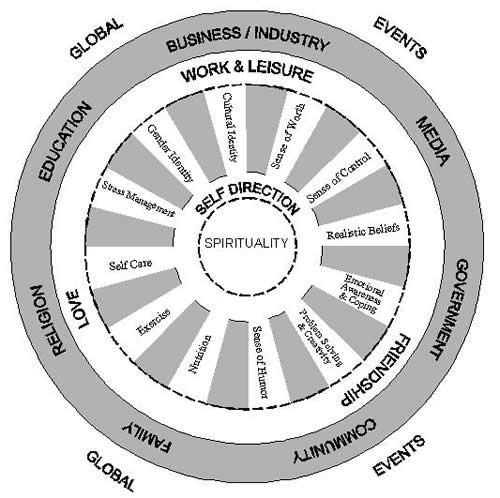
Welcome to the first Wellness Wednesday post of 2012! It might be good to take a moment to refresh your memory about the Wheel of Wellness, and my wellness page includes every past "Wellness Wednesday" post! Remember that wellness isn't the absence of the negative, but the presence of the positive in our lives.

Remember that I'm using the Wheel of Wellness to help visualize health in life:


Today we will continue discussing Life Task 2 (Self-Direction), and begin discussing the subtask of "Stress Management".

Myers & Sweeney define "Stress Management" the following way:

General perceptions of one’s own self-regulation, seeing change as an opportunity for growth rather than as a threat to one’s security, ongoing self-monitoring and assessment of one’s coping resources, structuring-ability to organize and manage resources (e.g., time, energy, seeing limits, scheduling); need for structure, satisfaction with one’s stress management ability.


Whew! That's quite a mouthful, right? Obviously there's quite a bit involved in stress management, so I'm planning to break this into a few different posts.

Today I'm going to briefly discuss "one's coping resources". A few weeks ago I wrote a post on Healthy Coping Skills that may be helpful for you in determining your own ways of coping. The interesting thing about coping is that it is an activity that can be done before, during, and after the stressful event. Of course this coping will look a little different each time, but it is important to implement this at various stages of stress. Family and Friends play a huge part in healthy coping, as does engagement in faith/religion (social integration is a key in stress management!).

Here are a few questions to ask yourself about how you cope:

  • What things do I naturally go towards to help myself cope with stress (i.e. food, alcohol, TV, music)?
  • Who can I count on in life to help provide coping support when I am stressed and overwhelmed?
  • What aspects of faith and spirituality can help me cope with stressors in my life?
  • What things can I do to cope that are healthy and safe for me?
  • How can I increase my sense of control in this situation to decrease my stress?
  • What things would be helpful to include in my "coping toolbox" so that I'm prepared when stress comes my way?
If you can establish a "coping plan" beforehand, then you'll have something prepared when stress and negative life events happen. Having a plan already created will instantly decrease some of your stress, and will provide you with people, places, and things that will be healthy for you!

Next Wednesday be on the lookout for Part 2 of the "Stress Management" subtask!

Now it's your turn:
What sorts of people, places, and things might be helpful for you to put in your "coping toolbox" so you're prepared for the stressful moments in life? Are there negative ways you cope that you would like to decrease?

Thursday, December 15, 2011

Healthy Coping Skills

"Coping refers to the thoughts and actions we use to deal with stress. In large part, feeling stressed or not depends on whether we believe we have the coping resources to deal with the challenges facing us. Most coping strategies fall into one of two broad categories:
  • Problem-focused coping strategies are used to tackle the problem directly. 
  • Emotion-focused coping strategies are used to handle feelings of distress, rather than the actual problem. 
In general, research has shown that problem-focused coping strategies are the most effective way for dealing with stress" (the above information is from this website). 

In this post I mentioned that it is beneficial to understand what our unhealthy coping mechanisms are in life (food, alcohol/substances, etc...), and learn to replace those with healthy coping mechanisms or skills. in coping we want to deal with the physical problems that are occurring, and we also want to address the emotions that go along with that situation. Given that this time of the year can be incredibly stressful (and because someone requested it!), here are a few healthy coping skills to practice and implement in your life. 

  • Attempt to increase your sense of control: In this post I discussed ways to increase or develop your sense of control in life. Implementing organizational strategies and setting small goals for yourself will help to increase your sense of control as well. (Food is NOT a healthy way to try to gain control, and can lead to an eating disorder)
  • Positive Reappraisal: This is simply what is sounds like it is. This process involves trying to view the positive within the situation in which you find yourself. This is about identifying the positive things that are happening instead of repeating the soundtrack of negative things that we find ourselves replaying. 
  • Addressing Cognitive Distortions: Challenge & Change the Irrational Beliefs that you might be holding on to. Any of the posts listed here under "Cognitive Distortions" will be helpful in addressing this. 
  • Writing: What goes on in our heads can sometimes be a jumbled mess, like someone took a handful of bouncy balls and let them go in our heads. If we can get all the stuff in our heads out onto paper (even the computer screen is better then nothing), we can sometimes develop a different perspective on the situation, or feel as if it is not so chaotic. This allows us to process the situation in a different way then simply by stressing out about it in our heads. Spend 10-15 minutes writing about the situation (or doing a free-write/stream of consciousness) and see what happens. 
  • Engage in Deep Breathing: Check out this post for steps to develop a practice of deep breathing. This will help to bring your heart rate and blood pressure down, and help you focus on the situation at hand. 
  • Exercise: But keep it balanced and moderate. Too much exercise can become unhealthy, just as no exercise is unhealthy. Engage in yoga, pilates, running, swimming, spinning, or some other form of exercise that will help combat some of the emotions you are experiencing. 
  • Engage in a hobby or activity you enjoy: Take a few minutes to take a long bath, watch a funny TV show, talk to a friend on the phone, write a letter to someone, play with pets, or volunteer. Here are a few other tips to refill yourself. 
  • Engage in or practice spiritual or religious activities: Spiritual communities can be a source of a great amount of support and encouragement. Some people find reading scriptures, prayer, or other similar activities to be encouraging. 
Ok, this is getting a bit long, so I will end my list of coping strategies at this point. The most important are to figure out ways that are helpful for you in various situations, and then practice these regularly. 

Now it's your turn:
What is one healthy coping skill you can commit to trying out and practicing in your life? 

Tuesday, August 23, 2011

Guest Post: How I Recovered Using the Principles of the Wellness Wheel {Part 1}

I'm so excited for you all to be able to read a two part guest post by RecoverReflect I'm a recent reader of RecoverReflect's blog myself, but everything I've read so far has been excellent! After reading her post, make sure to swing by her blog and check it out! Thank you so much for posting here today and Thursday!


Hello everyone! I’m RecoverReflect from Recovery Reflections! I write about all facets of eating disorder recovery, using my own experiences as inspiration for others. I am excited and honored to be writing the following guest post for Wellness Wednesdays and I’d love for you to stop by my blog and say hi! But, without further ado…

As per the Wellness Wheel, spirituality is at the core of our being, the essence of our soul. Having suffered from an eating disorder, it took me many years to understand, define, and accept who I truly am. If you would have asked me 10 years ago to explain my spirituality, I would not have even been able to answer. Now, healthy and recovered, I have made conscious efforts in developing “me” and can finally articulate my spirituality. For me, spirituality encompasses several aspects of my being:

·      My optimism for myself, others, and the world in general
·      My belief in a higher power
·      My tolerance and acceptance for those different than myself
·      My appreciation for the simple pleasures in life
·      My purpose in life: I truly believe (and have believed since I was in the midst of my eating disorder) that I went through my eating disorder so I can effectively help others who are suffering (hence my career choice as a psychologist)

Identifying, defining, and loving the aspects of my core were the first essential steps I had to take in order to begin recovering from my eating disorder. And now, years later, I look at the Wellness Wheel and understand why: spirituality is at the center of all other aspects of one’s wellbeing. Without it, how can one purposefully begin to fulfill and enhance the other aspects of the self?

After analyzing the 12 subtasks of the Wellness Wheel, the two that stuck out for me most as I reflected back on my recovery were self-care and sense of worth. These were two aspects of wellness that were severely disturbed and disrupted from my eating disorder. However, once I began my journey through recovery and developed my sense of spirituality, I began to work on each of these aspects of wellness, slowly but surely. Because self-care and sense of worth were not obvious underlying symptoms of my eating disorder (like exercise, nutrition, emotional awareness and coping, and realistic beliefs were) they were not the first areas on which I focused to improve and make healthy. However, having finally concentrated on these two aspects of wellness, I feel they have profoundly changed my life for the better.

Self-care. Through years of therapy and personal discovery, I gave up my self-destructive habits and behaviors. This satisfied my doctors, parents, and friends. I was no longer starving, over exercising, or purging. I was eating a “normal” amount of calories and maintaining a healthy weight. However, for me this wasn’t enough. I was in this state of neutrality, not hurting myself, but also not doing anything special or caring for myself. At first, this idea of “self-care” did not even occur to me. It was through my spirituality that I realized I deserved to be more than neutrally existent. I deserved to enjoy life. How did spirituality relate to this?

·      My optimism for myself, others, and the world in general gave me hope for a better, enjoyable life.
·      My belief in a higher power helped me believe that God did not want me to be living in a life with out happiness and self care.
·      My tolerance and acceptance for those different than myself helped me realize that my compassion for others could also be applied to myself.
·      My appreciation for the simple pleasures in life gave me a better outlook on life in general, which helped me see my life as worthwhile.
·      My purpose in life: I truly believe (and have believed since I was in the midst of my eating disorder) that I went through my eating disorder so I can effectively help others who are suffering (hence my career path to become a psychologist). Having such a purpose in life gives me reasons to maintain my health, not only physically, but mentally and emotionally, as well.


Make sure to check back on Thursday for Part 2 of this post!