Showing posts with label Cognitive distortions. Show all posts

Tuesday, April 24, 2012

How To Survive A Break Up {Part 4}

"People can be more forgiving than you can imagine. But you have to forgive yourself. Let go of what is bitter and move on."
-Bill Cosby

When going through a break up, it's easy to feel helpless, like there's nothing you can do but be a victim to grief and sadness. While the sadness will still be there, there are still a number of things that you can choose to do to keep yourself healthy and not make the grief worse then it already is.

Here are a few more tips for surviving a break up in a healthy way:
  • Love yourself. Focus on loving and taking care of yourself in the best way possible. This sort of combines engaging in self care behaviors, engaging in fun behaviors, and focusing on the positives in yourself, and it is very important. 
  • Try as best as possible to forgive yourself and the other person. Sometimes things happen in relationships that cause it to fall apart. If you were the cause of the problems, do your best to not beat yourself up, but instead learn from what happened and forgive yourself. If it was the other person, holding onto bitterness will just keep you trapped in a prison of negativity. Try to embrace forgiveness as best as you can.
  • Challenge & Change the cognitive distortions that can easily creep into our every day thoughts. These types of thoughts are not only irrational, but also negative and will lead to more anxiety and depression instead of allowing you to heal. Try to ensure that your thoughts are as rational as possible (click here for some helpful hints for doing this)
  • Give yourself permission to take the time that you need. Grieving a relationship can take a large range of time to "get over", from a month or two to several months. Don't beat yourself up when you don't feel happy and back to normal as quickly as you might feel is appropriate. Grief takes time, so give yourself permission to grieve fully and heal in a healthy manner. 

Now it's your turn!
What makes loving ourselves so difficult (in good times and in bad)? 

Thursday, February 2, 2012

Treatments For Seasonal Affective Disorder

Continuing on with my discussion on Seasonal Affective Disorder, today I'll be talking about how to treat it. There are a number of ways to treat seasonal affective disorder. Like traditional depression, a combination of medication and therapy may be incredibly helpful.
In regards to therapy, the following steps will likely be discussed:

Another step that can be taken to help treat Seasonal Affective Disorder is the use of light therapy (also known as phototherapy). In this type of therapy "you sit a few feet from a specialized light therapy box so that you're exposed to bright light. Light therapy mimics outdoor light and appears to cause a change in brain chemicals linked to mood" (source). An important side note- the light therapy, while helpful, can increase symptoms for those who have bipolar disorder. Please talk to your doctor before purchasing a box!

In the morning while getting ready, eating breakfast, or reading, you can turn on the light and let it hit your eyes. This will mimic the sun and not only help wake you up in the morning, but will help change the levels of chemicals and hormones in your body that will regulate mood, among other things! Some insurance companies will help cover the costs of this, so talk to your doctor! For anyone living in a place with little sunlight in the winter, this can be a great asset to overall health and a feeling of wellness in life! 

As with depression, there are other lifestyle and environmental changes you can make to help aid in treating this disorder. Keep blinds open to allow for light (even if it isn't sunny outside) to fill your house. Get out and move. With depression that's generally one of the last things you want to do, but getting outside and moving can greatly help overall mood. Surrounding yourself with good social supports and not isolating is also incredibly important. 


Now it's your turn:
Have you ever heard of light therapy before? What steps do you take in the winter to keep your mood up? 

Wednesday, January 18, 2012

Wellness Wednesday: {Stress Management Part 3}

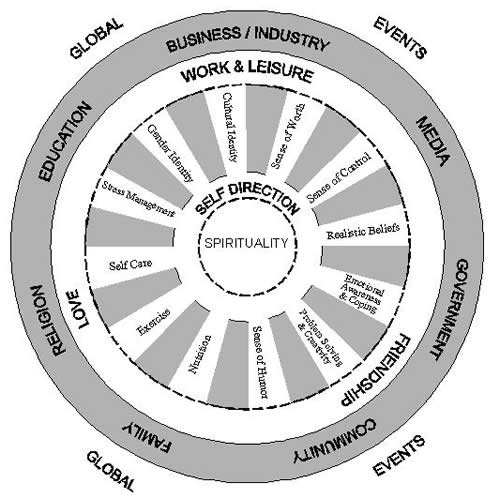
Welcome back to Wellness Wednesday! It might be good to take a moment to refresh your memory about the Wheel of Wellness, and my wellness page includes every past "Wellness Wednesday" post! Remember that wellness isn't the absence of the negative, but the presence of the positive in our lives.
Remember that I'm using the Wheel of Wellness to help visualize health in life:


This will be my last post on the subtask of stress management. You can check out part 1 and part 2 here.
Hopefully you are starting to realize that dealing with stress is crucial to your health, and that while it is definitely difficult to deal with at times, it is worth the time and effort.

Here are a few tips for starting to come up with a plan for stress management in your life:

  • Learn to say no and limit yourself: It's easy to overcommit ourselves. It makes us feel important, it helps us avoid having to deal with "real life problems", or it allows us to continue in our people pleasing. Learning to set boundaries and say no will help limit the number of controllable stressors in your life. We need to learn to say no appropriately, and there are limits to what you can give. You may need to say no to things that are good in life in order to not over spend yourself.  (to learn more about boundaries, click here and scroll down to the "boundaries" heading).
  • Establish a regular practice of deep breathing: Deep Breathing will help control your heart rate, blood pressure, and allow your focus and concentration to increase: all necessary things in controlling our stress! I like to set an alarm for a few times during the day to practice. When you notice yourself starting to get stressed, immediately start deep breathing. 
  • Decrease your unhealthy coping skills, and implement healthy coping skills: Check out this post I wrote on healthy coping. Our unhealthy coping skills, while they seem to work initially, actually create more stress in the long run. Practice and implement healthy coping skills to help effectively decrease your stress. 
  • Don't Use Words Too Big For the Subject: In this post I did on using appropriate language, I talked about the possible detrimental ramifications on using words that are too big for the subject at hand. Watch how you talk to yourself when you're stressed. If you're using words like "horrible", "terrible", "completely overwhelming", "unbearable" or other similar words, you're likely to not only increase your feelings of stress dramatically, but you are less likely to function well in the middle of the situation. Use words that are appropriate for the situation. 
  • Engage in Self Care: In the midst of a crazy schedule and stress, the last thing that seems important is taking time to take care of yourself. Check out this post on self care for ways to take care of yourself!
There are a few easy ways to care for yourself and decrease your stress on a regular basis. Come back tomorrow for a post on not playing the victim role to the stress in our lives! 

Now it's your turn:
What's your favorite way to stand up to stress? Why do we use words that are too big for the subject that we are talking about? How can we feel ok about saying no appropriately! 

Tuesday, January 17, 2012

Our Body's Reaction To Stress

The last few weeks in my Wellness Wednesday posts I've been discussing the subtask of stress management. In case you've missed it, here are the posts in this mini-series:

Wellness Wednesday: {Stress Management Part 1- Healthy Coping}
Wellness Wednesday: {Stress Management Part 2-Eustress}

I thought it might be helpful to explain what actually happens when we get stressed. When we start to feel stressed, our body needs to increase its cardiovascular output in order to bring oxygen and energy to certain muscles. Our body puts out a large amount of stress hormones, which can lead to the following progression:
  • Increased heart rate
  • Increased blood pressure
  • Hypertension
  • Accumulation of plaque on the inner lining of blood vessels, which can lead to heart attacks or cardiac death
  • Neuropsychological changes in affect and behavior
Stress is no joke, but we tend to brush it off, refuse to take the time to deal with it, or even chase after it. During stressful times, our immune system can be negatively impacted because:
  • immune organs shrink
  • disease-fighting cells can be decreased in both number and function
Then there are the changes that we tend to easily recognize when we start feeling stressed:
  • Our appetite can change
    • Some lose their appetite and feel sick
    • Others eat turn to junk food because they crave the simple carbs
    • Either way we aren't giving our body what it needs to function & remain healthy
  • Irritability increases (which can deeply affect relationships)
  • Irrational thoughts become more frequent (leading to increase in anxiety & depressed feelings)
So let me say this again: Stress is no joke! I know it's easy to get into a cycle where we get busy and overwhelmed, and the last thing we think of doing is taking time out of our crazy schedule to cope with the stress in a healthy way. When we're in stress mode, the thought of taking energy to decrease the stress is far from our minds. However, we need to do that which goes against what we naturally want to do: we need to fight the stress and cope with it in healthy ways in order to keep ourselves well both physically and mentally.

Part of the problem is that we get so focused on stress that we sometimes ignore the physical cues that our body sends out, and we find ourselves drowning in stress without realizing it. Here's my challenge to you: Learn the physical cues your body sends out so you can deal with it at the beginning instead of finding yourself drowning in it.

Now it's your turn:
How does your body respond to stress? Does it ever seem like you're too busy to deal with stress? What might the results of this be? 

Friday, December 30, 2011

Favorite Blog Posts From 2011

I know it's been a little quite here the last few days, but I've been enjoying time with my family and friends. I'll be back to regular posting next week! In the meantime, for my "Friday Favorites" post I thought I would do a summary of my favorite blog posts from 2011! Enjoy!

5 top posts from the year:


Some of my favorite posts from the year:

  • Challenging & Changing Cognitive Distortions - The post has a lot of good information about transforming your thinking patterns to allow for greater health and happiness in your life!
  • Thoughts of A Perfectionist - Not only does this post address thinking patterns of the perfectionist, but links to the other posts from the series on perfectionism that I did.
  • It's Not About Me!
  • The Series on Grieving and Loss- this link will take you to various posts by topic. This series is under "loss". I feel like this is good information to know, and can help us deal with suffering and loss in healthy and realistic ways!
  • Don't Use Words Too Big For The Subject - Ways to change our word choice to align with reality. 
  • The Series on OCD- I linked to the final post in this series, but it will take you to all the other posts as well! I hope that those who are struggling, or who have a loved one who is struggling, can find information like this and be able to recognize and understand it better!
  • "You Don't Understand" - We've all heard (or said) that phrase before, haven't we? This post discusses that simple little phrase, and how it changes conversation and relationships.
  • Healthy Coping Skills- It's good to use and practice good coping skills, isn't it? This post discusses categories of coping, and addresses ways to cope with things in a healthy manner.
It was honestly pretty hard to choose my favorite posts from the year. These aren't necessarily entertaining, but they contain information that is helpful or even crucial for living a healthy and happy life! 

Now it's your turn:
Link to your favorite blog post from the year in the comments section!

Thursday, December 15, 2011

Healthy Coping Skills

"Coping refers to the thoughts and actions we use to deal with stress. In large part, feeling stressed or not depends on whether we believe we have the coping resources to deal with the challenges facing us. Most coping strategies fall into one of two broad categories:
  • Problem-focused coping strategies are used to tackle the problem directly. 
  • Emotion-focused coping strategies are used to handle feelings of distress, rather than the actual problem. 
In general, research has shown that problem-focused coping strategies are the most effective way for dealing with stress" (the above information is from this website). 

In this post I mentioned that it is beneficial to understand what our unhealthy coping mechanisms are in life (food, alcohol/substances, etc...), and learn to replace those with healthy coping mechanisms or skills. in coping we want to deal with the physical problems that are occurring, and we also want to address the emotions that go along with that situation. Given that this time of the year can be incredibly stressful (and because someone requested it!), here are a few healthy coping skills to practice and implement in your life. 

  • Attempt to increase your sense of control: In this post I discussed ways to increase or develop your sense of control in life. Implementing organizational strategies and setting small goals for yourself will help to increase your sense of control as well. (Food is NOT a healthy way to try to gain control, and can lead to an eating disorder)
  • Positive Reappraisal: This is simply what is sounds like it is. This process involves trying to view the positive within the situation in which you find yourself. This is about identifying the positive things that are happening instead of repeating the soundtrack of negative things that we find ourselves replaying. 
  • Addressing Cognitive Distortions: Challenge & Change the Irrational Beliefs that you might be holding on to. Any of the posts listed here under "Cognitive Distortions" will be helpful in addressing this. 
  • Writing: What goes on in our heads can sometimes be a jumbled mess, like someone took a handful of bouncy balls and let them go in our heads. If we can get all the stuff in our heads out onto paper (even the computer screen is better then nothing), we can sometimes develop a different perspective on the situation, or feel as if it is not so chaotic. This allows us to process the situation in a different way then simply by stressing out about it in our heads. Spend 10-15 minutes writing about the situation (or doing a free-write/stream of consciousness) and see what happens. 
  • Engage in Deep Breathing: Check out this post for steps to develop a practice of deep breathing. This will help to bring your heart rate and blood pressure down, and help you focus on the situation at hand. 
  • Exercise: But keep it balanced and moderate. Too much exercise can become unhealthy, just as no exercise is unhealthy. Engage in yoga, pilates, running, swimming, spinning, or some other form of exercise that will help combat some of the emotions you are experiencing. 
  • Engage in a hobby or activity you enjoy: Take a few minutes to take a long bath, watch a funny TV show, talk to a friend on the phone, write a letter to someone, play with pets, or volunteer. Here are a few other tips to refill yourself. 
  • Engage in or practice spiritual or religious activities: Spiritual communities can be a source of a great amount of support and encouragement. Some people find reading scriptures, prayer, or other similar activities to be encouraging. 
Ok, this is getting a bit long, so I will end my list of coping strategies at this point. The most important are to figure out ways that are helpful for you in various situations, and then practice these regularly. 

Now it's your turn:
What is one healthy coping skill you can commit to trying out and practicing in your life? 

Thursday, November 3, 2011

The Practice of Gratitude and Thankfulness

The very first post I wrote on this blog was entitled "The Thankfulness Project" (check it out here). On Thanksgiving we focus on what we're thankful for, but after the day is over and we're consuming our copious amounts of delicious leftovers, we easily forget to continue living a life of gratitude. The practice of gratitude and daily thankfulness is incredibly healthy for us, both physically and mentally.

I recently stumbled across an article entitled "Boost Your Health With A Dose Of Gratitude". In the article, the author outlined a number of benefits that the practice of thankfulness has on our lives:
  • It helps decrease our stress levels: The article suggests that: "Gratitude research is beginning to suggest that feelings of thankfulness have tremendous positive value in helping people cope with daily problems, especially stress," Because stress accounts for 80-90% of all physical illness, when we choose to actively combat our stress, we help decrease our likelihood to get sick. 
  • Regularly thankful people are more likely to engage in self care behaviors
  • Immune Buster: When we are thankful, we have a more optimistic view on our life. The article suggests that: "Optimism also has a positive health impact on people with compromised health. In separate studies, patients confronting AIDS, as well as those preparing to undergo surgery, had better health outcomes when they maintained attitudes of optimism."
In another article on CNN, they outlined a few other benefits of thankfulness: 
University of California at Davis researchers found that practicing gratitude can lower your blood pressure and make you feel less hostile. Grateful people are less angry, less negative and usually look for the cup half full. Studies by Cornell University researchers have shown that those who are thankful appear to have lower risks of developing phobias, alcoholism, even depression. They even have stronger immune systems.


That sounds like a good deal, doesn't it? Are you convinced yet that the practice of thankfulness is beneficial to your life? Obviously it's not enough to realize that we need Thankfulness in life to be healthy. We need to take it one step further and develop a regular practice of gratitude in life. Here are a few suggestions:

  • Create a Thankfulness Journal: Keep a notebook on your nightstand and write it in it every morning or evening. Can you think of 5 things every day that you are thankful for? These can be anything "having a bed to sleep in" to "a promotion at work" or "my child didn't wake me up at all last night". When we start to develop this practice, we automatically start looking for things throughout the day to put on our list. This helps us develop mindfulness with gratitude. 
  • Choose 1 day a week to write a quick note or email to someone who you feel thankful for: It doesn't have to be long, but expressing our thanks to someone is healthy. Again, it doesn't have to be something huge. Maybe a co-worker picked up coffee for you on a tough day! Take time to write a few quick sentences to let them know how much you appreciated it!
  • Challenge the Cognitive Distortions in Life: Distorted thinking will change your positive thoughts to negative and irrational thinking. This steals joy and gratitude from our lives. Learn to Challenge and Change your Distorted thoughts. 
  • Develop a Gratitude Practice at Dinner Each Night: As a family, have each member around the table list one or two things they are thankful for from the day. This will allow each member to hear a number of positive aspects of the day, and will get children in the practice of gratitude from a young age. 
This is what it comes to. If you don't have a practice of gratitude in life, what's the alternative? If you aren't focusing on gratitude and the positive in life, what are you focusing on in life? How does this affect your mood, your relationships, and your overall health?

I challenge you to start a daily practice of gratitude in life. Develop a Thankfulness Project routine in life to help each member in your family increase their overall health and wellness. It's something quick and easy to do that yields great results. Again, what's the alternative?

Now it's your turn:
Do you have a regular practice of gratitude in life? If you do, what steps do you take? If not- what has led to you not practicing this regularly? What is one thing you could commit to this month that will lead to developing a practice of gratitude? 

Wednesday, October 26, 2011

OCD Awareness: {Help! Someone I Love Has OCD! part 1}

If a loved one has OCD, there are things that you can do to either hurt or help the situation. With a little knowledge, support, and research, you can be the healthiest individual you can be in helping support your loved one. Here are a few steps that you can take:


  1. Educate yourself and your family on OCD: OCD can be complicated and difficult to understand. On the surface, it doesn't make sense why an individual MUST do something to right something that has happened or something they thought about. When you educate yourself on the disorder, this begins to make a bit more sense. Reading books and finding websites, as well as talking to a doctor or therapist, will help you learn about the disorder. 
  2. Get support for yourself: From online and "in person" support groups, these can also be beneficial not only in educating yourself, but in processing your own thoughts and behaviors. 
  3. Engage in self-care behaviors: It can be draining at times in dealing with someone struggling with an illness or disorder. Taking care of yourself is essential to not only keep yourself healthy, but also to provide healthy support to those around you. Here are some ideas to help get you started! 
  4. Learn to identify cognitive distortions & start changing them! We each have cognitive distortions that sneak their way into our thinking patterns. Learn to change these in your own conversation, as well as helping those around you start changing. There are a number of cognitive distortions that are prevalent in OCD, and it's important that your loved one know these as well. Click here for information on Challenging & Changing Cognitive Distortions. 
  5. Learn to set healthy boundaries in your life: This will not only help you to engage in self-care, but it will also help you to maintain a healthy relationship with your loved one(s). Click here and scroll down to "boundaries" for a list of posts I've done on this topic. 
Part 2 of "Help! Someone I Love Has OCD!" will be coming tomorrow. Keep your eyes out! (I'd also like to mention that these steps listed above are helpful for ANY mental disorder, not just OCD).

Friday, October 21, 2011

Friday Favorites

Favorite Delight of the Week
Pumpkin decorations in my office and house! When fall hits, I love spreading out all my little pumpkins and gourds around the house. This also helps me in my practice of mindfulness. It's fall, and while I want to be stressed about the fact that winter is coming, I'm choosing to enjoy where I am in the present. Pumpkins help with mindfulness:)


Favorite Quote of the Week

"Confidence on the outside begins by living with integrity on the inside."
-- Brian Tracy

Favorite Post By Someone Else
My Thyroid Story- Running With Sass  Heather has some fantastic information on Thyroid functioning. I highly suggest reading the post and educating yourself on the signs and symptoms. It's also important to note that sometimes thyroid malfunctioning can look like depression. It's good information to know:)


Favorite Search Terms

Tuesday, September 20, 2011

Moving From "Have To" to "Choose To" in College & Career

Remember the post I did a few weeks ago on my advice for college students? If not, I'd check it out.
To continue my trend of passing along wisdom about college, I thought I'd share something that I see in many of my clients, as well as the friends I had when I was in college (and even sometimes myself back when I was in school!).
I want to share a perspective that, if taken to heart and added to your life, could change the way you view school and your purpose there. By the way, this perspective isn't JUST for college students, and applies just as much to your work environments as well.

We are each susceptible to different cognitive distortions. One of these is the idea of "must" and "have to". How many times in your own life do you think something along the lines of "UGH, I have to do _____ and I really don't want to." My next thought is always: You don't HAVE to. You are choosing to.

You see, what we do in our lives is something that we control. If we do or don't do a homework or work assignment, if we don't show up for work or class, and if we fail- it's all our choice and responsibility alone. All of college and career is a series of choices.

Here's an example:
"Ugh- I have to write this paper on depression for my psychology class and I'm really annoyed that I even have to do it." I'm probably going to be angry, stressed, and possibly even resentful the entire time I'm working on the paper.
But what if I changed that thought to this:
"I'm choosing to write this paper on depression because I'm choosing to participate in and do well in my psychology class so that I can get grades that are good because I'm choosing to want to be in the field of psychology and counseling." That's a different perspective, isn't it? I still have to write the paper, BUT I am owning the fact that I am choosing to do this paper as part of a class I'm choosing to take because I chose a specific major because I chose a job field that I love and am interested in being a part of.

Here's another example:
"Ugh, I don't want to have to go to work tomorrow and I definitely don't want to have to do that work project." Again, stress, frustration, anger, or possible depression- everything we try to avoid if we're trying to be healthy individuals.
Let's switch it around a little:
"I'm choosing to go to work tomorrow and choosing to complete this project because I'm choosing to be active in a job that provides for me and my family." That changes perspective a bit, doesn't it?


My point in all of this is the following:
Ultimately, the things we do every day are a result of the choices we make. However, it's easy for each of us to view our lives as a series of "have to" activities being thrust upon us by others. This certainly won't lead to health and peace in our lives, will it?

What would happen if you and I (and those around us!) were able to change perspective from "have to" to "choose to"? What would be different?

Now it's your turn?
Do you or someone close to you get caught up in the "have to" in life? What are the results? What might be different if you replaced "have to" with "choose to" in your life? Are you willing to give it a try and see?

Wednesday, August 17, 2011

Wellness Wednesday: {Realistic Beliefs}

Welcome back to Wellness Wednesday! If you haven't read the rest of the series, you can catch up on the posts here:
Wellness Wednesday: {An Introduction}
Wellness Wednesday: {An Introduction pt. 2}
Wellness Wednesday: {The Wheel of Wellness Part 1}
Wellness Wednesday: {The Wheel of Wellness Part 2}
Wellness Wednesday: {Life Task 1: Spirituality}
Wellness Wednesday: {Life Task 2: Self Direction}
Wellness Wednesday: {Sense Of Worth}
Wellness Wednesday: {Sense of Control}

For those of you who have read some of the posts, you might recall that I'm using the idea of the Wheel of Wellness to visually represent wellness for the individual.


Last week I talked about the second subtask of self direction, which was "sense of control". Today we will be moving on to the third subtask: Realistic Beliefs.

Myers & Sweeney define Realistic Beliefs the following way:
Ability to perceive truth/reality accurately (i.e., accurate information processing), lack of unrealistic expectations/wishful thinking.


If you're new to my blog, you may not know that I LOVE talking about cognitive distortions and changing irrational thinking to rational and realistic thinking. This was an area of wellness that I struggled severely with through high school and college, and it took a lot of hard work to start changing this around. There's a lot I could say here about this area of wellness, but I've done a series of posts on this topic that will give you the most information about the topic. Here are the links:
When we distort our beliefs about ourself and the world, our mental health tends to plummet. When we hold to irrational beliefs, are relationships tend to become strained, and our ability to connect well is diminished. I cannot possibly emphasize how important having realistic and rational beliefs is to our overall health and wellness. The problem- thoughts can be distorted ever so slightly, and we don't realize it. As it distorts further, it becomes difficult to realize, and thus makes it harder to change. The "Challenging & Changing Cognitive Distortions" link will give you many clear steps to help with realistic thinking! 

We each struggle with realistic beliefs at some point. When are your unrealistic beliefs most likely to be triggered? How do you challenge your unrealistic beliefs? 

Wednesday, August 3, 2011

Wellness Wednesday: {Sense of Worth}

Happy Wellness Wednesday! For myself personally, I love doing these Wednesday posts, as they are a good check and reminder for myself as well. If you've missed any of the posts, here are the previous posts for Wellness Wednesday:

Wellness Wednesday: {An Introduction}
Wellness Wednesday: {An Introduction pt. 2}
Wellness Wednesday: {The Wheel of Wellness Part 1}
Wellness Wednesday: {The Wheel of Wellness Part 2}
Wellness Wednesday: {Life Task 1: Spirituality}
Wellness Wednesday: {Life Task 2: Self Direction}

For those of you who have read some of the posts, you might recall that I'm using the idea of the Wheel of Wellness to visually represent wellness for the individual.


Last week I introduced the second life task, which is Self Direction. Within the second life task there are 12 subtasks. Right now I'm planning to start at the top and work my way around the circle clock wise. 
Today, I'm discussing the first subtask: Sense of Worth.

Myers, Sweeney, and Witmer define this subtask the following way:


Satisfaction with self, acceptance of self with one’s imperfections, acceptance of one’s physical appearance, valuing oneself as a unique, worthwhile person.


The term sense of worth could also be interchanged here with "self esteem". 

When I think of self-esteem I naturally think "can you be ok with you and love yourself for who you are?" I believe that's what self esteem boils down to. Unfortunately, there are a lot of things that chip away at our self-esteem: being bullied, harsh or abusive words and actions by a family member, or unrealistic expectations of self to name a few. We can easily become a mangled piece of who we originally were, and it can take a lot of energy and strength to remain strong in who we are in the hot fire of the world. 

I've been a lot of posts throughout this blog on various things that help to increase ones sense of worth in life. Here are some of the links:

Boundaries: Establishing healthy boundaries helps define what is me, and what is not me, what is my responsibility, and what things are the responsibility of others. A lack of boundaries can lead to a confusion of one's identity, so to have a strong sense of worth, healthy boundaries are important to implement. (Click here to find the boundaries category of posts)

Cognitive Distortions: When we distort ourselves, the world around us, or even others in our life, we can easily confuse things. These distortions can distort our identity and sense of self. To have a healthy sense of worth, it's important to try to decrease the cognitive distortions used in every day life. (Click here to find the cognitive distortions category of posts)

Perfectionism: As the definition above says, sense of worth involves acceptance of one's imperfections. If a person holds to perfectionistic standards, they will constantly be a failure to one's self, which obviously will decrease a sense of worth. (Click here to find the perfectionism category of posts)

Affirmations: Awhile back I wrote about using affirmations as a way to increase self esteem. I've seen this help a large number of clients, and believe that this is a very helpful component. You can click here to read about it!

Accepting Your Physical Appearance: I wrote a post on developing a healthy body image, which is part of having a healthy sense of worth. You can click to read it here.

Each of these posts that I've linked to includes steps that you can take to help with your journey. Remember that health is a never ending process, so give yourself time to work on changes! Self esteem doesn't happen overnight!

What is one thing that helps you have a strong sense of worth in life?
What makes you a unique, individual person?

Saturday, July 23, 2011

Don't Use Words Too Big For The Subject

Don't use words too big for the subject. Don't say "infinitely" when you mean "very"; otherwise you'll have no word left when you want to talk about something really infinite. 
- C.S. Lewis


If you've read this blog for very long, you know that I love talking about cognitive distortions! If you've missed some of the basic posts, you can check them out here:


One way we can distort our thinking is by assigning words that are inappropriate for the situation. This can make us feel even more anxious, stressed, depressed, or angry. Here are some examples:

  • "I'm SO ANGRY at that person!" Ok...are you really SO ANGRY, or just a little annoyed? You'll be more likely to feel more and more angry at the person if you continue to say how angry you are.
  • "I'm COMPLETELY OVERWHELMED right now!" Let's step back for a minute. Are you actually completely overwhelmed, or are you a little busier and stressed then is ideal for you?
You get the idea. We often use words that are inappropriate for the situation, which can blow the situation out of proportion. Plus, when we are in a situation that is really terrible or completely overwhelming, what word will use to describe the situation. Interesting thought, isn't it? I expanded this idea a little in the post I linked above called "What's the Deal with all the catastrophizing"...I think it's worth checking out! 

I think it's incredibly easy for most of us to use inappropriate words in situations. I sure struggle with it. I grew up definitely exaggerating a lot of feelings, and I didn't realize until college how damaging and destructive this can be. It's been a many year battle to try to decrease this behavior in my life, and while I've often been successful, I still have those moments. I think that's part of being human. We may never be completely able to cut it out, but we can decrease it, and therefore make ourselves just a little healthier! 

Here's what I'd like to know:
Is it easy for you to assign an incorrect word to a feeling or a situation? 

Tuesday, July 12, 2011

How You Think When You Lose

"How you think when you lose determines how long it will be until you win." 
-G.K. Chesterton

Throughout the last few months on this blog, I've talked a lot about cognitive distortions, how to challenge these, how our thoughts & feelings deeply affect behavior, and how our definitions of success and failure are crucial in our behaviors and attitudes. 

Here are a few of these posts:
When we lose at something in life, we have two choices. We can beat ourselves/the other person up, complain, and quit, OR we can learn from what went wrong, and create a game plan for the future. That is the choice that YOU and YOU ALONE have to make for yourself. I see people blaming a situation for years, and in the meantime they've missed out on a number of opportunities because of the way they were talking to themselves. Please don't cheat yourself in life. Do yourself a favor, and learn to fail better in life! You deserve it:)

How do you talk to yourself when you lose?
What is one thing you'd like to commit to in order to help yourself "fail better"?

Friday, July 1, 2011

Fantastic Fridays (Life's Tiny Delights)

Enjoy the little things, for one day you may look back and realize they were the big things.

-Robert Brault

I have to admit that I REALLY look forward to my Friday posts all week. It's not because I think they're amazing or anything like that, but because it's starting to change how I view my entire week! And that's the goal, isn't it? To get the background on my Friday posts, you can click here.

With the start of spring, my tiny delight for the week has been: SUNSHINE! After a long week of rain, it was nice to feel the sun beating down on me once again (and catch a few days at the pool). I sometimes get so focused on my life and responsibilities that I miss what's going on around me. So this week, it was all about focusing on the sunshine. Here are a few pictures I snapped throughout the week:


Pretty, isn't it? I definitely don't feel like I get enough days of sun a year, but this week instead of grumbling about that fact, I chose to be happy for the time I did have to see the sun!

And for a little Friday Fun, here are some of the searches people did to find my blog:
  • how to deal with catastrophizing
  • chobani for my diet/chobani for lactose intolerance (this seems to get lots of hits a week...)
  • identity perfectionism
  • morning oatmeal with chocolate and peanut butter (i hope this person tried it and Loved it!)
  • counseling encyclopedia- cognitive distortion
Have a great start to the weekend, and enjoy the sunshine:)

What I'd like to know:
Do you prefer sunny or overcast days?
Do you have any fun plans for this holiday weekend?