Showing posts with label Self Worth. Show all posts

Wednesday, February 8, 2012

Wellness Wednesday: {A Review Of Life Task 2}

Welcome back to Wellness Wednesday, a fun mid-week look at the areas of wellness in our lives. To remind you, in talking about wellness I'm discussing the positive factors in life that help protect us from the events of life. Wellness is therefore not about the absence of the negative, but the presence of the positive. I just finished talking about the 2nd (out of 5) life tasks, and I thought this would be a good time for us to review these components.


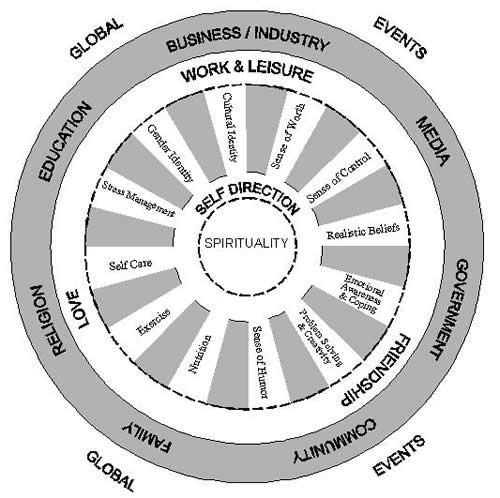
Life Task 2 is made up of 12 subtasks:

A few questions to get you thinking:
  1. What is your greatest area of strength? 
  2. How does this strength further your overall wellness?
  3. What are your greatest areas of improvement?
  4. What is one step in each of these areas that you can take to help improve those areas? 
  5. How does your overall wellness in nutrition affect your stress management?
  6. What's one new healthy coping skill that you could implement?
It's interesting to think about how the health in one area of our life affects our health in another (either positively or negatively). It's important to regularly evaluate how each of the areas of our wellness is currently impacting us. 

Now it's your turn!
What are your thoughts on wellness in your life? What areas are easier to be healthy in, and what areas are a little more difficult? 

Thursday, August 25, 2011

Guest Post: How I Recovered Using the Principles of the Wellness Wheel {Part 2}


If you missed Part 1 of RecoverReflect's guest post, click here to catch up!

In order to maintain a healthy balance in my overall wellness, I take time to do things I enjoy:
1.     Craft. I love crafting, scrapbooking, drawing, and painting. Being creative is a great outlet for me.
2.     Hot bath. I love taking a hot bubble bath and just soaking. It is a time that I permit myself to stop thinking completely about any stress I am under.
3.     Stay in touch. Isolation is a huge trigger for slip ups for me, so I actively take time to maintain relationships I have with friends and family.
4.     Exercise. Now that I can exercise in moderation, this is a huge factor in my ability to care for myself physically and mentally. Exercise clears my mind, kicks up my endorphins, and keeps me feeling healthy and making healthy choices for myself.
5.     Playlists. I make new playlists all the time to boost my mood. I also love singing at the top of my lungs on my drives to and from work, so they come in handy then, too.

Sense of worth. Before recovery, I felt the only way to stand out and be worthy was to starve myself/be sick. And, even through recovery, I struggled with feeling worthy of recovery. I didn’t feel like I belonged anywhere without my eating disorder “identity.” However, again, through definition of my spirituality, I was able to develop a sense of worth.
·      My optimism for myself, others, and the world in general gave me the desire to help others improve their lives.
·      My belief in a higher power gave me the belief that I am here for a reason.
·      My tolerance and acceptance for those different than myself helped me see that everyone serves a purpose in this world.
·      My appreciation for the simple pleasures in life gave me a sense of grounding and gratefulness.
·      My purpose in life: I truly believe (and have believed since I was in the midst of my eating disorder) that I went through my eating disorder so I can effectively help others who are suffering (hence my career choice as a psychologist). Having a purpose in life gave me a reason to live. It gave me a reason to heal, a sense of identity, and something to strive for. By choosing to help others recover, I feel purposeful, worthy, and powerful.

While there are many subtasks that I have already explored greatly within myself in order to achieve wellness, learning about the Wellness Wheel through Musings of a Counselor’s posts has helped me greatly. I have identified areas of my wellness that I have ignored and have chosen to start working on them. For example, I have not put much thought or paid much attention to Gender Identity, Cultural Identity, or Sense of Humor. However, I now realize how important these dimensions are in overall wellness, and I am excited to continue my pursuit of health, happiness, and recovery with the help of the Wellness Wheel.


Thanks so much for you awesome two part guest post! I hope that you'll go over and check out Recovery Reflections blog!

Wednesday, August 3, 2011

Wellness Wednesday: {Sense of Worth}

Happy Wellness Wednesday! For myself personally, I love doing these Wednesday posts, as they are a good check and reminder for myself as well. If you've missed any of the posts, here are the previous posts for Wellness Wednesday:

Wellness Wednesday: {An Introduction}
Wellness Wednesday: {An Introduction pt. 2}
Wellness Wednesday: {The Wheel of Wellness Part 1}
Wellness Wednesday: {The Wheel of Wellness Part 2}
Wellness Wednesday: {Life Task 1: Spirituality}
Wellness Wednesday: {Life Task 2: Self Direction}

For those of you who have read some of the posts, you might recall that I'm using the idea of the Wheel of Wellness to visually represent wellness for the individual.


Last week I introduced the second life task, which is Self Direction. Within the second life task there are 12 subtasks. Right now I'm planning to start at the top and work my way around the circle clock wise. 
Today, I'm discussing the first subtask: Sense of Worth.

Myers, Sweeney, and Witmer define this subtask the following way:


Satisfaction with self, acceptance of self with one’s imperfections, acceptance of one’s physical appearance, valuing oneself as a unique, worthwhile person.


The term sense of worth could also be interchanged here with "self esteem". 

When I think of self-esteem I naturally think "can you be ok with you and love yourself for who you are?" I believe that's what self esteem boils down to. Unfortunately, there are a lot of things that chip away at our self-esteem: being bullied, harsh or abusive words and actions by a family member, or unrealistic expectations of self to name a few. We can easily become a mangled piece of who we originally were, and it can take a lot of energy and strength to remain strong in who we are in the hot fire of the world. 

I've been a lot of posts throughout this blog on various things that help to increase ones sense of worth in life. Here are some of the links:

Boundaries: Establishing healthy boundaries helps define what is me, and what is not me, what is my responsibility, and what things are the responsibility of others. A lack of boundaries can lead to a confusion of one's identity, so to have a strong sense of worth, healthy boundaries are important to implement. (Click here to find the boundaries category of posts)

Cognitive Distortions: When we distort ourselves, the world around us, or even others in our life, we can easily confuse things. These distortions can distort our identity and sense of self. To have a healthy sense of worth, it's important to try to decrease the cognitive distortions used in every day life. (Click here to find the cognitive distortions category of posts)

Perfectionism: As the definition above says, sense of worth involves acceptance of one's imperfections. If a person holds to perfectionistic standards, they will constantly be a failure to one's self, which obviously will decrease a sense of worth. (Click here to find the perfectionism category of posts)

Affirmations: Awhile back I wrote about using affirmations as a way to increase self esteem. I've seen this help a large number of clients, and believe that this is a very helpful component. You can click here to read about it!

Accepting Your Physical Appearance: I wrote a post on developing a healthy body image, which is part of having a healthy sense of worth. You can click to read it here.

Each of these posts that I've linked to includes steps that you can take to help with your journey. Remember that health is a never ending process, so give yourself time to work on changes! Self esteem doesn't happen overnight!

What is one thing that helps you have a strong sense of worth in life?
What makes you a unique, individual person?

Saturday, March 12, 2011

The Development of Perfectionism {Part 1}

When discussing Perfectionism with clients, I usually ask them something like "What do you think started this pattern of beliefs and expectations in your life." Of course I'm not expecting them to always know the reason why, but it's interesting to hear the brainstorming that occurs. Some people talk for a few minutes with a lot of "i don't knows" thrown in, while others immediately can list a series of expectations put on them by parents that they believe have led to the perfectionism in their life.

Perfectionism can't always be pinpointed to one person or one moment in time. It can be complex, with a number of factors, experiences, and people involved. One of the prominent ways people seem to develop perfectionism is through other-imposed standards and expectations.

A child learns that by following the expectations and standards of those around her, she is able to avoid an argument, beating, or "make the parent happy" when she is perfect (or perfectly meets the expectations). "Implicit in the social expectations model is the notion that children who are not capable of meeting parental expectations will experience a chronic sense of helplessness and hopelessness as a result of their inability to meet the standards imposed on them...a sense of contingent self-worth is a central aspect of socially prescribed perfectionism" (Elliot & Hewitt, 2002, p. 90). Parents, or others close to us in life, can create a way of life where our self-worth is contingent on our achievement or looks. In this sort of system, we quickly learn that when we fail to achieve, we don't have worth and aren't "ok". Not only are we "not ok", but depression, anxiety, and stress, along with feeling unloved, can result.

Social learning basically suggests that we learn in a social context, through the words and actions (the modeling) of those around us. Even if parents don't put perfectionistic expectations on their children, they can model the "importance" of perfectionistic standards to their children in how they speak about themselves. Children tend to think and speak like their parents do, and when it comes to things that are unhealthy, this modeling is obviously a little dangerous.

Also, interestingly enough, "perfectionism was associated with guilt, psychological distress, and a maladjusted family of origin...correlations that reflected a lack of intimacy and autonomy" (Elliot & Hewitt, 2002, p. 97). I found that interesting. The more controlling and stifling the family is, the more likely perfectionism will develop.

*you can find the rest of my series on perfectionism here.

I will leave it at that for the day.
So what do you think? Did your own family of origin lead to perfectionistic standards in your own life? 


Elliot, G.L., & Hewitt, P.L. (2002). Perfectionism: Theory, Research, and Treatment. american psychological association.