Showing posts with label Development. Show all posts

Wednesday, January 4, 2012

Wellness Wednesday: {Stress Management Part 1- healthy coping}

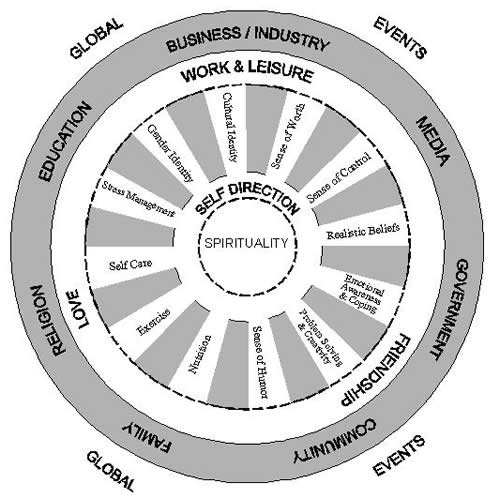
Welcome to the first Wellness Wednesday post of 2012! It might be good to take a moment to refresh your memory about the Wheel of Wellness, and my wellness page includes every past "Wellness Wednesday" post! Remember that wellness isn't the absence of the negative, but the presence of the positive in our lives.

Remember that I'm using the Wheel of Wellness to help visualize health in life:


Today we will continue discussing Life Task 2 (Self-Direction), and begin discussing the subtask of "Stress Management".

Myers & Sweeney define "Stress Management" the following way:

General perceptions of one’s own self-regulation, seeing change as an opportunity for growth rather than as a threat to one’s security, ongoing self-monitoring and assessment of one’s coping resources, structuring-ability to organize and manage resources (e.g., time, energy, seeing limits, scheduling); need for structure, satisfaction with one’s stress management ability.


Whew! That's quite a mouthful, right? Obviously there's quite a bit involved in stress management, so I'm planning to break this into a few different posts.

Today I'm going to briefly discuss "one's coping resources". A few weeks ago I wrote a post on Healthy Coping Skills that may be helpful for you in determining your own ways of coping. The interesting thing about coping is that it is an activity that can be done before, during, and after the stressful event. Of course this coping will look a little different each time, but it is important to implement this at various stages of stress. Family and Friends play a huge part in healthy coping, as does engagement in faith/religion (social integration is a key in stress management!).

Here are a few questions to ask yourself about how you cope:

  • What things do I naturally go towards to help myself cope with stress (i.e. food, alcohol, TV, music)?
  • Who can I count on in life to help provide coping support when I am stressed and overwhelmed?
  • What aspects of faith and spirituality can help me cope with stressors in my life?
  • What things can I do to cope that are healthy and safe for me?
  • How can I increase my sense of control in this situation to decrease my stress?
  • What things would be helpful to include in my "coping toolbox" so that I'm prepared when stress comes my way?
If you can establish a "coping plan" beforehand, then you'll have something prepared when stress and negative life events happen. Having a plan already created will instantly decrease some of your stress, and will provide you with people, places, and things that will be healthy for you!

Next Wednesday be on the lookout for Part 2 of the "Stress Management" subtask!

Now it's your turn:
What sorts of people, places, and things might be helpful for you to put in your "coping toolbox" so you're prepared for the stressful moments in life? Are there negative ways you cope that you would like to decrease?

Monday, March 14, 2011

The Development of Perfectionism {Part 2}

I took a break in my series on perfectionism to talk about why I wasn't complaining. If you haven't checked it out yet, you can read it here . While you're at it, if you haven't read Part 1 of the Development of Perfectionism yet, check it out here before going on...then come back here:) So, in the last post on perfectionism, I introduced the idea of the development of perfectionism, I discussed a little about social learning, and the expectations and standards of others.

In Elliot &Hewitt's 2002 book entitled Perfectionism: Theory, Research, and Treatment, they discussed the family environment of perfectionism. Here are some of the things they discovered in the connection between family characteristics and perfectionism:


  • Maternal rejection or shaming behavior
  • Low levels of maternal tolerance and affection
  • Higher levels of parental overprotection & control
  • Shame by those around the person
  • Poor health in the family of origin
  • Low parental care
  • Parental control & perfectionism was also indicated in the development of eating disorders
These characteristics tend to lead to self-oriented perfectionism, instead of some of the characteristics from yesterday, which lead to more others-oriented perfectionism. There are also personal characteristics of the child that tend to lead to implementing more perfectionistic standards in life. These include:
  • Temperament (aspects of a person's personality that are innate, like introversion or extroversion) 
    • "We believe that perfectionists have a temperament that is characterized by high levels of emotionality, including high fearfulness, along with high levels of persistence" (Elliot & Hewitt, 2002, p. 111). 
  • Attachment Style (the way you interact with others in more intimate relationships)
  • Ability of the child to be influenced by those around him or her
  • Personal definitions of success & failure
  • Distorted thinking
  • People Pleaser
It's important to remember that perfectionism doesn't generally develop solely because of one factor. There's usually some mixture of environmental, parental, & personal factors that lead to holding perfectionistic standards in life. Knowing the "why" of perfectionism doesn't necessarily help to change it (you can spend hours in therapy trying to figure out why you are thinking the way you do, or you can spend a little time discussing it, and then dive into challenging and changing those standards), but sometimes it helps us understand that we aren't "just nuts" like we sometimes can believe. 

Ok, this was a very brief, tip of the iceberg, explanation on how perfectionism can develop. Understanding this can help give us some answers to why we are the way that we are, and it can help to inform our behaviors when we raise children of our own. Knowing all of this, we need to start changing how we think and what our standards are, so that we don't remain stuck in the trap of perfectionism.

*you can find the rest of the posts in my series on perfectionism here.

If you struggle with perfectionistic tendencies, can you see anything that might contribute to the development of it in your life? Are you ready to start challenging your thinking?

Saturday, March 12, 2011

The Development of Perfectionism {Part 1}

When discussing Perfectionism with clients, I usually ask them something like "What do you think started this pattern of beliefs and expectations in your life." Of course I'm not expecting them to always know the reason why, but it's interesting to hear the brainstorming that occurs. Some people talk for a few minutes with a lot of "i don't knows" thrown in, while others immediately can list a series of expectations put on them by parents that they believe have led to the perfectionism in their life.

Perfectionism can't always be pinpointed to one person or one moment in time. It can be complex, with a number of factors, experiences, and people involved. One of the prominent ways people seem to develop perfectionism is through other-imposed standards and expectations.

A child learns that by following the expectations and standards of those around her, she is able to avoid an argument, beating, or "make the parent happy" when she is perfect (or perfectly meets the expectations). "Implicit in the social expectations model is the notion that children who are not capable of meeting parental expectations will experience a chronic sense of helplessness and hopelessness as a result of their inability to meet the standards imposed on them...a sense of contingent self-worth is a central aspect of socially prescribed perfectionism" (Elliot & Hewitt, 2002, p. 90). Parents, or others close to us in life, can create a way of life where our self-worth is contingent on our achievement or looks. In this sort of system, we quickly learn that when we fail to achieve, we don't have worth and aren't "ok". Not only are we "not ok", but depression, anxiety, and stress, along with feeling unloved, can result.

Social learning basically suggests that we learn in a social context, through the words and actions (the modeling) of those around us. Even if parents don't put perfectionistic expectations on their children, they can model the "importance" of perfectionistic standards to their children in how they speak about themselves. Children tend to think and speak like their parents do, and when it comes to things that are unhealthy, this modeling is obviously a little dangerous.

Also, interestingly enough, "perfectionism was associated with guilt, psychological distress, and a maladjusted family of origin...correlations that reflected a lack of intimacy and autonomy" (Elliot & Hewitt, 2002, p. 97). I found that interesting. The more controlling and stifling the family is, the more likely perfectionism will develop.

*you can find the rest of my series on perfectionism here.

I will leave it at that for the day.
So what do you think? Did your own family of origin lead to perfectionistic standards in your own life? 


Elliot, G.L., & Hewitt, P.L. (2002). Perfectionism: Theory, Research, and Treatment. american psychological association.