Showing posts with label behaviors. Show all posts

Thursday, March 15, 2012

How To Survive A Break Up {Part 3}

"No one told me that grief felt so like fear...at other times it feels like being mildly drunk, or concussed. There is a sort of invisible blanket between the world and me. I find it hard to take in what anyone says. "
-C.S. Lewis, A Grief Observed, p. 3

Welcome back to another edition of how to survive a breakup in a healthy way that will allow you to become a healthier individual in the future.

Here are a few more tips to survive the breakup in a healthy manner:

  • Focus on getting through today, not the next week or month. 12 step programs focus on staying sober "just for today", because thinking about going without their "drug of choice" forever is overwhelming. We can do anything for today. Instead of being miserable that you'll be without this person for forever, can you focus on surviving and grieving in a healthy way "just for today"?
  • Continue to engage in healthy behaviors as much as you can. It can be incredibly difficult to maintain a healthy lifestyle while you're grieving, but it will help you stay healthy and grieve in an effective way if you can manage. Maintaining a consistent daily schedule is important. Continue to eat balanced meals, exercise as best you can, sleep 7-8 hours a day, etc... 
  • Find fun activities to distract yourself, or pick up a new hobby. Sign up for a cooking or sewing class, or perhaps sign up for a few sessions of personal training in order to better learn a new type of exercise. Go out for a fun girls or guys weekend away or have a "staycation" at a friend's house.
  • Make sure to not create negative messages about yourself. It can be pretty easy to internalize messages like "I'm not good enough", "I'm unloveable", or "I don't have any attractive qualities". Believing these messages will keep you depressed and won't allow you to grieve in healthy ways. Focus on the positive attributes and skills you have, and combat your negative thoughts when they come up. 

Now it's your turn!
What are some of the fun activities you use to distract yourself when you're stressed or going through a tough time? 

Tuesday, February 7, 2012

Surviving The Winter Blues

Many of us notice a decrease in mood in the winter, even if we don't experience Seasonal Affective Disorder. While it can be difficult to motivate yourself or feel happy in a day, there are things that we can do to help get us through the winter blues.


  • Participate In A Hobby: A hobby can be beneficial to decrease overall stress, can increase enjoyment, and give us something to look forward to. It can help increase our motivation and allow us to feel a sense of accomplishment. Each of these things is important for helping us feel better when we have the "winter blues". 
  • Plan Fun Activities: Having an event to look forward to helps to perk us up a bit and can get us excited and motivated! This provides laughter, enjoyment, fun, and social support. Sometimes when we feel down, having something fun to look forward to at the end of the week can help motivate and "get you through" that week. 
  • Exercise: I know, I know. I think many of us get sick of being told to move. However, there's a reason that people talk about it so much. It's healthy, impacts multiple areas of wellness, and really does help! Even getting outside and going on a walk with friends can be helpful!
  • Volunteer: Getting outside of ourselves can be helpful in increasing our mood. If you have the time, find a place you can volunteer. Some places you can go for 1-2 hours one time, or you could find a place to volunteer a few hours a week! 
  • Get out of the house: Walk around the mall, read at a coffee shop, hang out with friends, go to a club or religious service. The temptation when mood goes down is to isolate. Isolation is the fuel for depression, so resist the urge to lock yourself in your room for days on end. 
  • Laugh! Whether it's with friends, watching a funny TV show, or looking at funny pictures online, laughter is healthy. Do it often:) 
  • Light Therapy:I've talked about this before, but using a light can help increase mood. Talk to your doctor before using one, however, as it could make mania worse in those who struggle with bipolar disorder. (you can find out more about this treatment here)
These are just a few of the things that have been helpful for me over the years in getting through the gray and gloomy months of winter. For more information on the "winter blues" or seasonal affective disorder, check out the other posts from this series:

Now it's your turn!
How do you survive the winter blues? What's your favorite hobby? 

Thursday, February 2, 2012

Treatments For Seasonal Affective Disorder

Continuing on with my discussion on Seasonal Affective Disorder, today I'll be talking about how to treat it. There are a number of ways to treat seasonal affective disorder. Like traditional depression, a combination of medication and therapy may be incredibly helpful.
In regards to therapy, the following steps will likely be discussed:

Another step that can be taken to help treat Seasonal Affective Disorder is the use of light therapy (also known as phototherapy). In this type of therapy "you sit a few feet from a specialized light therapy box so that you're exposed to bright light. Light therapy mimics outdoor light and appears to cause a change in brain chemicals linked to mood" (source). An important side note- the light therapy, while helpful, can increase symptoms for those who have bipolar disorder. Please talk to your doctor before purchasing a box!

In the morning while getting ready, eating breakfast, or reading, you can turn on the light and let it hit your eyes. This will mimic the sun and not only help wake you up in the morning, but will help change the levels of chemicals and hormones in your body that will regulate mood, among other things! Some insurance companies will help cover the costs of this, so talk to your doctor! For anyone living in a place with little sunlight in the winter, this can be a great asset to overall health and a feeling of wellness in life! 

As with depression, there are other lifestyle and environmental changes you can make to help aid in treating this disorder. Keep blinds open to allow for light (even if it isn't sunny outside) to fill your house. Get out and move. With depression that's generally one of the last things you want to do, but getting outside and moving can greatly help overall mood. Surrounding yourself with good social supports and not isolating is also incredibly important. 


Now it's your turn:
Have you ever heard of light therapy before? What steps do you take in the winter to keep your mood up? 

Tuesday, January 31, 2012

Symptoms of Seasonal Affective Disorder

Following a discussion on what seasonal affective disorder is and what causes it, it's only natural to now discuss the signs and symptoms of the disorder itself.

The Mayo Clinic lists the following as symptoms of fall and winter SAD (source):

  • Depression
  • Hopelessness
  • Anxiety
  • Loss of Energy
  • Heavy, "leaden" feeling in the arms or legs
  • Social withdrawal
  • Oversleeping
  • Loss of interest in activities you once enjoyed
  • Appetite changes, especially a craving for foods high in carbohydrates
  • Weight gain
  • Difficulty concentrating
Of course if an individual is experiencing this symptoms year round, it's likely they are experiencing depression, and not specifically seasonal affective disorder. And, of course, we all have days that we feel at least some of these feelings. However, if you are experiencing this symptoms for more days then not for a few weeks, it is important to contact your health care provider. If you are experiencing suicidal thoughts, please contact your doctor, go to the hospital, or call 911.

Now it's your turn:
After looking at this list, do you think either you or someone close to you has experienced SAD? 

Thursday, January 26, 2012

Causes of Seasonal Affective Disorder

Today I'll be continuing my discussing on Seasonal Affective Disorder. If you missed my introductory post on the definition of SAD and who it affects, you can check that post out here.

Today I'll be looking at the causes of SAD. This is a bit tricky, as the actual cause of the disorder is fairly unknown. The Mayo Clinic suggests that "it's likely, as with many mental health conditions, that genetics, age and, perhaps most importantly, your body's natural chemical makeup all play a role in developing the condition" (source). Because this disorder primarily happens in the winter, when there is a lack of sunlight, it leads people to believe that sunlight plays a big role in this disorder.

The Cleveland Clinic suggests the following: "One theory is that with decreased exposure to sunlight, the biological clock that regulates mood, sleep, and hormones is delayed, running more slowly in the winter. Another theory is that brain chemicals that transmit information between nerves, called neurotransmitters (for example, serotonin), may be altered in individuals with SAD" (source).

So, it appears that a number of contributors such as the body's natural rhythm, hormone & other chemical levels, and exposure to light all play a role in seasonal affective disorder.

Now it's your turn to share:
Any thoughts on the "winter blues"? What's one thing you do to stay happy and healthy in the winter? 

Wednesday, January 25, 2012

Wellness Wednesday: {Gender Identity}

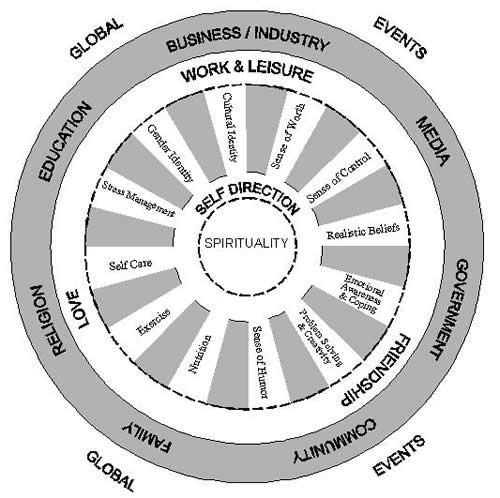
Welcome back to Wellness Wednesday! It might be good to take a moment to refresh your memory about the Wheel of Wellness, and my wellness page includes every past "Wellness Wednesday" post! Remember that wellness isn't the absence of the negative, but the presence of the positive in our lives.


Remember that I'm using the Wheel of Wellness to help visualize health in life:


Today we'll be moving on to our next subtask of Life Task 2: Gender Identity. Only one more subtask for Life Task 2 to go!

Myers & Sweeney define this subtask the following way:

Satisfaction with one’s gender identity, feeling supported in one’s gender, valuing relationships with people of both genders, transcendence of gender identity, competency to cope with stress of gender identity.


This can be a hot topic for people, and I'm glad that this was included in the 17 components of wellness! It obviously goes without saying that if we don't feel valued and accepted for who we are, that will affect our emotions and our health. I also think it goes without saying that we shouldn't belittle someone or make jokes at someone's expense simply because of their gender.

A few questions to get you thinking:

  1. How are you supportive of people in regards to their gender?
  2. Are there any words or actions you use that devalue a person because of their gender? If yes, what can you do to change this?
  3. Do you have friends of both genders? If no, what makes you stick to one and not the other? 
  4. Why are friendships with both genders healthy?
  5. Do you ever experience stress because of your gender? If yes- what are some coping skills you can use to stay healthy? 
  6. How do you embrace your gender identity?
  7. How does health, or a lack of health, impact other components of wellness? 
Now it's your turn:
What are some ways we can show value to each person and help others to feel supported in their gender? What are some ways you see people devaluing others based on their gender? Other thoughts on gender identity? 


Tuesday, January 17, 2012

Our Body's Reaction To Stress

The last few weeks in my Wellness Wednesday posts I've been discussing the subtask of stress management. In case you've missed it, here are the posts in this mini-series:

Wellness Wednesday: {Stress Management Part 1- Healthy Coping}
Wellness Wednesday: {Stress Management Part 2-Eustress}

I thought it might be helpful to explain what actually happens when we get stressed. When we start to feel stressed, our body needs to increase its cardiovascular output in order to bring oxygen and energy to certain muscles. Our body puts out a large amount of stress hormones, which can lead to the following progression:
  • Increased heart rate
  • Increased blood pressure
  • Hypertension
  • Accumulation of plaque on the inner lining of blood vessels, which can lead to heart attacks or cardiac death
  • Neuropsychological changes in affect and behavior
Stress is no joke, but we tend to brush it off, refuse to take the time to deal with it, or even chase after it. During stressful times, our immune system can be negatively impacted because:
  • immune organs shrink
  • disease-fighting cells can be decreased in both number and function
Then there are the changes that we tend to easily recognize when we start feeling stressed:
  • Our appetite can change
    • Some lose their appetite and feel sick
    • Others eat turn to junk food because they crave the simple carbs
    • Either way we aren't giving our body what it needs to function & remain healthy
  • Irritability increases (which can deeply affect relationships)
  • Irrational thoughts become more frequent (leading to increase in anxiety & depressed feelings)
So let me say this again: Stress is no joke! I know it's easy to get into a cycle where we get busy and overwhelmed, and the last thing we think of doing is taking time out of our crazy schedule to cope with the stress in a healthy way. When we're in stress mode, the thought of taking energy to decrease the stress is far from our minds. However, we need to do that which goes against what we naturally want to do: we need to fight the stress and cope with it in healthy ways in order to keep ourselves well both physically and mentally.

Part of the problem is that we get so focused on stress that we sometimes ignore the physical cues that our body sends out, and we find ourselves drowning in stress without realizing it. Here's my challenge to you: Learn the physical cues your body sends out so you can deal with it at the beginning instead of finding yourself drowning in it.

Now it's your turn:
How does your body respond to stress? Does it ever seem like you're too busy to deal with stress? What might the results of this be? 

Thursday, January 12, 2012

Motivation for Change

If you don't know where you are going, you will probably end up somewhere else.  ~Lawrence J. Peter

Motivation is when your dreams put on work clothes.  ~Author Unknown

Over the past few weeks I've addressed a number of aspects of behavior change that people tend to skip over on their way to attempting to change something in their life. Here are the previous posts in this series:

Before you start to change behavior, it's good to know why you'd like to change your behavior. The fact of the matter is that behavior change can be a difficult, long, hard, tedious process. There needs to be something we hold on to that will continue to motivate us forward when we want to give up (and for most of us, that time will come at some point). As you think about your dreams and what you'd like to achieve through behavior change, I'm wondering if you know what is motivating yourself forward. This "what" and "why" will help keep you going when the voice inside tells you to give up, that it isn't worth the time, energy, or work involved. 

Once you figure out what that motivation will be, write it down somewhere and read it regularly. A bathroom mirror or refrigerator are both good places to put motivations, as we tend to look at those places many times a day. The more we repeat something, the more it becomes an automatic thought. Because thoughts lead to our feelings and our behaviors, we need to get our thoughts right before we move forward. 

Let's look at a few examples:
Goal: Get healthy by working out 3 days a week (2 days running, 1 day biking)
Motivation: I'm choosing to exercise and get healthy because I desire to __________. (fill in the blank could be anything like the following: be an active grandparent one day, live a long, healthy life, feel better and stronger about myself).

Goal:  Correct my distorted thoughts and change these to rational thinking patterns
Motivation: I'm choosing to do the hard work of learning to challenge and change my distorted thinking patters because I want to ______. (fill in the blank. i.e. decrease the depressed or anxious feelings I experience, be a good role model to my children, be happier each day). 

See what I mean? This step, combined with the steps listed above, will start to set you up in the best way possible for being successful at your behavior change. 

We each do what we do for a specific reason. It's helpful to find out what the reason is that we engage in our current behavior, and create a new motivation for our new behavior. 

Now it's your turn:
What are some of your "motivations" for the year?

Wednesday, January 11, 2012

Wellness Wednesday: {Stress Management Part 2- Eustress}

Welcome back to Wellness Wednesday! It might be good to take a moment to refresh your memory about the Wheel of Wellness, and my wellness page includes every past "Wellness Wednesday" post! Remember that wellness isn't the absence of the negative, but the presence of the positive in our lives.


Remember that I'm using the Wheel of Wellness to help visualize health in life:


Today I'm continuing my discussion on the subtask of Stress Management. You can see "part 1" of this subtask here.

I don't think we can have a real discussion on stress management without discussing what "stress" actually means. What IS stress, then? Basically, it's your body's physical and psychological response to anything that you perceive as overwhelming, alarming, or threatening. It's a biological process, with a wide-ranging set of events in the body.

Here's the thing: Not All Stress Is Bad! Sometimes I believe we are trained to think that any and all stress is a bad thing, and we start to panic when we feel stress coming on in our lives. But not all stress is bad, and, in fact, a small amount of stress is actually good for us! Even good stress (i.e. a new job, marriage, or a baby) can become unhealthy and taxing on the body if not properly dealt with.

How is stress good? Here are a few things that stress actually provides for us:

  • initiates invention & problem-solving capabilities and moves us towards creativity
  • It can give us that final push towards making changes or adapting to something
  • It can keep us healthy and happy
  • It pushes us out of our "love affair" with comfort (we can't live within this comfort zone all the time, because we won't change or grow. We become stagnant. Good stress actually helps us be "ok" with getting outside our comfort zone). 
Watch how you react the next time you start feeling a slight amount of stress. Do you panic and freak yourself out? Remember, what we think affects our feelings and our behaviors. The more you say "I'm stressed, I'm so stressed out, I'm overwhelmed", the more you feel overwhelmed and out of control". If you can acknowledge that you are feeling a slight amount of stress and you are choosing to engage with it in a healthy manner, it becomes manageable, and won't take over your life. Does that make sense? 

Here's your challenge: Watch how you talk to yourself when you start feeling stressed? Do you ramp your stress up, or do you acknowledge it for what it is without freaking out?

Now it's your turn:
Do you ramp up your stress level more then it needs to be? How can you use stress for your advantage without letting it overwhelm you?

Wednesday, January 4, 2012

Wellness Wednesday: {Stress Management Part 1- healthy coping}

Welcome to the first Wellness Wednesday post of 2012! It might be good to take a moment to refresh your memory about the Wheel of Wellness, and my wellness page includes every past "Wellness Wednesday" post! Remember that wellness isn't the absence of the negative, but the presence of the positive in our lives.

Remember that I'm using the Wheel of Wellness to help visualize health in life:


Today we will continue discussing Life Task 2 (Self-Direction), and begin discussing the subtask of "Stress Management".

Myers & Sweeney define "Stress Management" the following way:

General perceptions of one’s own self-regulation, seeing change as an opportunity for growth rather than as a threat to one’s security, ongoing self-monitoring and assessment of one’s coping resources, structuring-ability to organize and manage resources (e.g., time, energy, seeing limits, scheduling); need for structure, satisfaction with one’s stress management ability.


Whew! That's quite a mouthful, right? Obviously there's quite a bit involved in stress management, so I'm planning to break this into a few different posts.

Today I'm going to briefly discuss "one's coping resources". A few weeks ago I wrote a post on Healthy Coping Skills that may be helpful for you in determining your own ways of coping. The interesting thing about coping is that it is an activity that can be done before, during, and after the stressful event. Of course this coping will look a little different each time, but it is important to implement this at various stages of stress. Family and Friends play a huge part in healthy coping, as does engagement in faith/religion (social integration is a key in stress management!).

Here are a few questions to ask yourself about how you cope:

  • What things do I naturally go towards to help myself cope with stress (i.e. food, alcohol, TV, music)?
  • Who can I count on in life to help provide coping support when I am stressed and overwhelmed?
  • What aspects of faith and spirituality can help me cope with stressors in my life?
  • What things can I do to cope that are healthy and safe for me?
  • How can I increase my sense of control in this situation to decrease my stress?
  • What things would be helpful to include in my "coping toolbox" so that I'm prepared when stress comes my way?
If you can establish a "coping plan" beforehand, then you'll have something prepared when stress and negative life events happen. Having a plan already created will instantly decrease some of your stress, and will provide you with people, places, and things that will be healthy for you!

Next Wednesday be on the lookout for Part 2 of the "Stress Management" subtask!

Now it's your turn:
What sorts of people, places, and things might be helpful for you to put in your "coping toolbox" so you're prepared for the stressful moments in life? Are there negative ways you cope that you would like to decrease?

Tuesday, December 20, 2011

Track Behavior Before You Change It!

January 1st, the New Year, the start of finally "getting healthy"... yup, that's right. It's time for New Years Resolutions or Goals. First of all, it is OK to not create a new goal for yourself for the year, and it is also ok to not create one until say, February or March. Setting goals is a healthy thing, no matter what time of the year it is!

 However, New Years Resolutions have become notorious for being "a joke"; they are something we tend to make but not actually follow through on in our life. So, before we get any closer to New Years, and you all creating some new goals for your life, I thought I would begin to discuss how to set yourself up for the greatest amount of success in meeting your behavior change goals.

Part of the reason why New Years Resolutions tend to not be followed through on is because the entire "behavior change process" isn't done in a successful manner. Have you ever heard the phrase "you can't change what you don't know"? (If you haven't, well, I guess you just did) That phrase really describes the entire behavior change process. People tend to just jump into behavior change without knowing how that behavior currently plays out in their life.

Here are a few steps to do BEFORE changing your behavior that will set you up for the greatest chance at success:


  1. Decide What Behavior You'd Like To Change: Obviously you'll need to choose a behavior or two that you would like to change. Make sure to not set too many, as it is easy to feel overwhelmed about the entire thing and quit.
  2. Track Your Current Behavior to Learn How It Plays Out In Life: That's right, I said track the behavior. Figure out what excuses you're making, what makes you less likely/more likely to engage in said behavior you'd like to change, and figure out what times of the day/situations/people won't aid this change. We engage in behaviors for a specific reason, and there is some benefit we get out of maintaining our present behavior. Figure out what that reason is! We need to know what our excuses are and what things make it difficult to be successful at that behavior change. Here's an example- I found myself eating a lot of unhealthy snacks when I got home from work while unwinding and cooking dinner. By the time I sat down for dinner, I wasn't all that hungry for the healthy stuff, and I felt frustrated by my lack of health. Because I took time to track behavior, I figured out that if I cut up veggies on Sunday nights, I would have a super easy and convenient healthy snack for myself. Tracking behavior is a crucial component for healthy behavior change, and it's often a step that people tend to skip. 
  3. Read Up and Educate Yourself On Your Desired Behavior Goal: If you want to start exercising, then look at the various exercise classes at a local gym to see if any interest you. Read up on various exercises and recommendations online. If you want to start eating healthy, look into some various meal plans and/or some healthy new foods and recipes to add into your meals. Spend some time getting to know what your behavior looks like as a "healthy behavior."
  4. DO NOT CHANGE YOUR BEHAVIOR YET. I know, I know. It's frustrating. Please be patient and track your behavior for a week or two and really get to know it. You'll most likely be MUCH more successful in the long run, and come into the behavior change experience feeling less frustrated and more prepared. 

So, over the next few weeks as you are itching to change your behavior, why not take some time to be proactive about your goals and set yourself up for the greatest amount of success possible? It's certainly not going to harm you...right? So give it a shot!

Now it's your turn:
Do you set goals for yourself for the New Year? If so, have you started to think about what behaviors you'd like to change or add into your life? 

Tuesday, October 4, 2011

Choose Today to Alter Tomorrow

“The consequences of today are determined by the actions of the past. To change your future, alter your decisions today.” ~ Anonymous


What initially caught my attention from this quote was that it reminds me of a verse from the Bible that says "Forgetting what lies behind and straining forward to what lies ahead, I press on toward the goal" (Philippians 3:13-14, ESV).  This is definitely one issue that I see with clients frequently. We have a hard time dealing with the past and moving forward. We like to clutch onto the past and drag it through the future with it, not releasing it and moving forward. 

When we are held back by the past, we don't allow the future to become what it has the potential of becoming. We can't go back and change the past. If we choose to not leave the past there and move forward, then it changes our future. TODAY we have the choice not to change or fix the past, but to change the future. We can't re-write the past, but we have the option to write the next chapter  in our lives. 

The point is that we need to make a decision to alter our choices so that our future DOES have the option to be different. A healthy life involves a series of choices. You may have made unhealthy choices in the past, but you can choose to stand up today and make choices that will change the course of your life. 

Thoughts for you:
What do you need to let go of and not drag it through our future? What choices can you make today that  have the potential to change the rest of your life?

Thursday, September 29, 2011

Your Opinion Isn't My Business

“Your opinion of me is none of my business.” –Randy Pausch, “The Last Lecture”

This post really should've been done many months ago, in my series on Boundaries. I suppose that we can each use a refresher in regards to boundaries on a regular basis, so this will serve as that refresher for each of you. If you started reading this blog after I did the series on Boundaries, please go back and read the posts. The concept of boundaries is one that is often overlooked, but is essential for maintaining a healthy life, and more importantly, healthy relationships. There is little chance of having healthy relationships if you cannot maintain boundaries with those people. 


A quick reminder: Boundaries "define what is me and what is not me" (Cloud & Townsend). This means that I need to know "what is me", and therefore what I am responsible for and what I can control in life. This means that I am responsible for my own thoughts, feelings, and behaviors. I am not responsible for the thoughts, feelings, and behaviors of others, and I cannot try to get others to take responsibility for MY thoughts, feelings, or behaviors. 


How does that, then, apply to the quote above? Why do we try to take on the things another thinks and make them our business, when having healthy boundaries clearly states that those things are outside our realm of control?


How much time, stress, energy, and anger do we invest on making another's opinion our business? Furthermore- how often do we change who we are because another doesn't like something about us? We try to fit in, or become a version of someone else instead of ourselves. It's a shame to lose who we are because we take on the opinions of others. 


Now it's your turn:
What do you try to make your business that is actually none of your business? What's happened when you take someone's opinion of you on as your business? 

Wednesday, August 24, 2011

Wellness Wednesday: {Emotional Awareness & Coping}

If you don't manage your emotions, then your emotions will manage you.  ~Doc Childre and Deborah Rozman, Transforming Anxiety

The walls we build around us to keep sadness out also keeps out the joy.  ~Jim Rohn

Instead of posting all the links from the previous "Wellness Wednesday" posts as I have been doing, I decided to create an entire tab on my blog which gives some information on wellness, along with a link to every post. You can check it out (& catch up on previous "Wellness Wednesday" posts) here.


Today I'll be focusing on another component of Life Task 2: Emotional Awareness & Coping! 

Myers & Sweeney describe Emotional Awareness & Coping as the following:


Being in touch with feelings, being able to express/disclose feelings appropriately, ability to respond spontaneously and appropriately to life experiences from the full  range of possible human emotional responses, enjoying positive emotions, coping with negative emotions, lack of chronic negative emotional states (E.g., anger), sense of energy (vs. depression)


One belief I hear often from people is that all negative emotion is bad. The truth is, however, that it is not, and to feel the entire range of human emotion is what is healthy and normal. In life it isn't about trying to hide or deny any negative emotion, but it's about recognizing and dealing with it. Emotion tells us a number of key things in our life, and when we don't identify it, we miss many valuable messages and bits of information. If we open ourselves up to emotion, we WILL feel the negative, but we will also feel the positive. We can't just selectively choose emotions, and therefore we can't force ourselves to only feel the positive. BUT we can learn to deal with the negative in such a way that the positive will have a much bigger foothold in our lives.

Many times in this blog I've talked about the thought-feeling-behavior connection. What we think changes how we feel, which changes how we behave. Learning to become aware of our feelings is essential, because without awareness, our feelings rule our actions and behaviors (and let's be honest- that can be scary!).

Many times in life we feel an emotion, but it's actually an emotion that is covering the emotion behind it. For instance, we are hurt that our friend bailed on Saturday plans. Instead of telling her how hurt you are, you instead lash out in anger, which makes you less vulnerable. In order to be emotionally well, we need to be able to ask ourselves if the emotion we are feeling is being used to cope with or cover over another emotion, and what's the need to not deal with the primary emotion up front.

There's a lot that I could discuss in dealing with emotional awareness and coping, but seeing as there are an incredibly number of emotions and situations we need to cope with, I cannot do this. I will leave, however, give you a list of questions to start yourself thinking:


  1. Am I in tune with what emotion I am feeling, or do my emotions sometimes confuse me?
  2. Do I feel the entire range of emotion (negative to positive)?
  3. Am I afraid of certain emotions or are some emotions unacceptable to feel?
  4. Do I use some emotions (like anger) to cover over other emotions (such as hurt)?
  5. Am I aware of what situations trigger emotion?
  6. Can I recognize negative emotion as it is building (verses as its boiling point)?
  7. Do I have coping strategies for my emotion & negative life events? 
  8. Are these coping strategies healthy or unhealthy?
Now it's your turn:
Do you feel like you have good coping skills for negative emotions? Do you sometimes use one emotion to cover over another emotion? How does emotion change your behavior?

Monday, July 25, 2011

Wellness Wednesday: {Life Task 2: Self Direction}

Welcome back to Wellness Wednesday! If you haven't read the rest of the series, you can catch up on the posts here:
Wellness Wednesday: {An Introduction}
Wellness Wednesday: {An Introduction pt. 2}
Wellness Wednesday: {The Wheel of Wellness Part 1}
Wellness Wednesday: {The Wheel of Wellness Part 2}
Wellness Wednesday: {Life Task 1: Spirituality}


For those of you who have read some of the posts, you might recall that I'm using the idea of the Wheel of Wellness to visually represent wellness for the individual.


Last week I discussed the first Life Task, Spirituality. Today I'll start with the 2nd Life Task: Self Direction.

Myers, Sweeney, & Witmer define Self Direction the following way:
"The process by which one directs, controls, manages the self in ways that are self-enhancing, within societal norms, through the following 12 subtasks". 

If you click on the picture above, you can find the 12 subtasks in the spokes of the wheel. These life tasks are about how you are living within the world, and includes things like realistic beliefs, stress management, emotional awareness and coping, and self care. I find that a few of these subtasks are often overlooked when it comes to defining wellness, and that is part of the reason why I love the concept of this Wheel. 

These 12 life tasks are positive, healthy traits of an individual that help lead to a decrease in stress and an increase in the resiliency of that person. Resiliency, of course, is important in helping an individual survive and come back from a difficulty in life. 

I'll be talking through the next 12 subtasks individually, so I don't want to go into too much detail in this post. 

A few things to think about:
1. What's one of the most surprising of the 12 subtasks under self direction?
2. Rank the order you believe for yourself from healthiest to least healthy. Is this ranking surprising to you?
3. How do you think your health (or lack there of) in one of these subtasks changes the wellness level of the other subtasks?


Wednesday, July 20, 2011

Wellness Wednesdays: {Life Task 1: Spirituality}

Welcome back to Wellness Wednesday! If you haven't read the rest of the series, you can catch up on the posts here:
Wellness Wednesday: {An Introduction}
Wellness Wednesday: {An Introduction pt. 2}
Wellness Wednesday: {The Wheel of Wellness Part 1}
Wellness Wednesday: {The Wheel of Wellness Part 2}

For those of you who have read some of the posts, you might recall that I'm using the idea of the Wheel of Wellness to visually represent wellness for the individual.


Today we will be moving to the first Life Task, which is Spirituality. This is placed at the center of the wheel, because spirituality is at the core of each individual. Now before I scare away those who don't consider themselves religious, just keep reading, and you'll understand what it all encompasses! 

This is how Myers, Sweeney, & Witmer define the Life Task of Spirituality:

Personal, private beliefs that enhance one’s life; hope and optimism, purpose in life, moral values, transcendence, over-all spiritual well-being.


Does religion play a role in spiritual wellness? Absolutely! Religion certainly can inform each of the aspects listed above, but if you don't hold to a certain religion, that doesn't mean that this life task is scratched out for you!

Each of us lives our life by a certain code of beliefs, morals, and values. At least we should! If we believe one way and act in another, this can cause great stress in our life. Our beliefs, optimism towards the future, and purpose in life affect every aspect of who we are. Looking at it that way, it makes sense as to why this would be at the center of the wheel, doesn't it? Having a purposeful meaningfulness to life helps one cope with difficulty and trouble, and is a huge component to the "hardiness of an individual". 

You can see the aspect of spirituality in the everyday sayings of individuals. For example, the Golden Rule of "Do unto others as you would have them do unto you" is a well-known phrase throughout many different cultures, countries, and religions. Living life as this phrase suggests would be an indicator for spiritual well-being. 

Here are a few questions to get you thinking:
  1. What breaks your heart and baffles your mind? How does this relate to your purpose in the world?
  2. Do you feel like you know what your purpose in life is, or are you still trying to figure out what it might be?
  3. What are the values in life that you believe are important? How do these play out in your life?
  4. Is there a relationship between your beliefs and values and how you behave in the world?
  5. How do you live life in a way that is true to yourself?
  6. Do you have hope & optimism for the future? If not, how might you begin to develop a sense of hope?
  7. How would you like to transform your life to become a more spiritual being?
What I'd like to know:
What other phrases besides the one mentioned above indicate a sense of "spirituality" within our culture?
Is this an easy component of wellness, or is it difficult to live life according to one's beliefs and values?

Wednesday, July 13, 2011

Wellness Wednesdays: {The Wheel of Wellness Part 2}

Welcome back to Wellness Wednesday! If you've missed the previous posts in the series, you may want to catch up on them here:
Wellness Wednesday: {An Introduction}
Wellness Wednesday: {An Introduction pt. 2}
Wellness Wednesday: {The Wheel of Wellness Part 1}

This week I'll give a little more information on the Wheel, and next week we'll jump in and start discussing the components of wellness. To give an overview of where we're heading, after that, I will be discussing steps to successful behavior change, and creating health habits.

To remind you, this is what the wheel looks like:


Here's what you need to know about the Wheel:
  1. The 5 main life tasks (spirituality, self direction, work & leisure, friendship, & love) are interrelated, and each has an effect on the other. The idea of the Wheel is that is explains not only the characteristics of wellness, but the nature of the relationship between these different characteristics. This is a very holistic view of the individual. 
  2. Changes in one area have a direct impact on other areas. So, without realizing it, by working on one area, you may notice changes in another area!
  3. Surrounding the Wheel are various global events and characteristics. We don't necessarily think that the media has an influence on our overall well being, but it does! An individual's wellness affects each of these global events (because, for example, the government is made up of a group of individuals with varying levels of wellness), and global events affect each one of us and our levels of wellness. 
  4. Because the levels of wellness from others affect our own levels, we need to be cognizant of how various factors (i.e. a certain family member or TV commercial) trigger our wellness. 
Alright, that's the basics you need to know about the wheel. Start getting excited, because next week we'll start a more in-depth look at each of these areas! 

Here's some possible next steps:
-Start evaluating what around you changes your levels of wellness, either in increasing it or decreasing it?
-What are some of the triggers for you?
- How can you help to fight against these triggers to increase your levels of wellness?

What I'd like to know:
Have you ever noticed something in the community, on TV, or in your family changing your level of wellness (either good or bad)? What did you do about it?
Are there any areas of wellness that you're thinking about trying to increase?


Tuesday, July 12, 2011

How You Think When You Lose

"How you think when you lose determines how long it will be until you win." 
-G.K. Chesterton

Throughout the last few months on this blog, I've talked a lot about cognitive distortions, how to challenge these, how our thoughts & feelings deeply affect behavior, and how our definitions of success and failure are crucial in our behaviors and attitudes. 

Here are a few of these posts:
When we lose at something in life, we have two choices. We can beat ourselves/the other person up, complain, and quit, OR we can learn from what went wrong, and create a game plan for the future. That is the choice that YOU and YOU ALONE have to make for yourself. I see people blaming a situation for years, and in the meantime they've missed out on a number of opportunities because of the way they were talking to themselves. Please don't cheat yourself in life. Do yourself a favor, and learn to fail better in life! You deserve it:)

How do you talk to yourself when you lose?
What is one thing you'd like to commit to in order to help yourself "fail better"?