Showing posts with label Wellness. Show all posts

Wednesday, March 14, 2012

Wellness Wednesday: {Boundaries at Work- Part 1}

Welcome back to Wellness Wednesday! If you're interested in other posts in this series, check out my Wellness page here. Right now I'm discussing Life Task 3 from the Wheel of Wellness, which is work and leisure. Past posts on the "work" component of wellness include:

Today I'm going to expand a bit more on the idea of work overload, and what to do if you find yourself working too much overtime, to the point of exhaustion (or the other signs & symptoms I posted above). 

Cloud & Townsend, in their book Boundaries, have a few thoughts on work overload. They state the following: "If you are in a situation in which you're doing lots of extra work because you "need the job" and because you are afraid of being let go, you have a problem. If you are working more overtime than you want to, you are in bondage to your job. You are a slave, not am employee under contract" (Boundaries, p. 198). 

Employers can take advantage very easily of people who choose to not say "NO" when asked about increasing job opportunities. If they know someone won't say no when they ask someone to stay late, don't you think that the employer is going to take advantage of that? If you are constantly working overtime, what do you think that does to your health (physical, mental, emotional, spiritual) and your relationships? It's not so great. 

Here are some tips they offer for dealing with this issue (quoted directly from book, p. 198):
1. Set boundaries on your work. Decide how much overtime you are willing to do. Some overtime during seasonal crunches may be expected of you. 
2. Review your job description, if one exists. 
3. Make a list of the tasks you need to complete in the next month. Make a copy of the list and assign your own priority to each item. Indicate on this copy any tasks that are not part of your job description. 
4. Make an appointment to see your boss to discuss your job overload. Together you should review the list of tasks you need to completely in the next month. Have your boss prioritize the tasks... You may also wish to review your job description with your boss at this time if you think you are doing things that fall outside your domain. 

A few of my own thoughts- I like the list above, and think many people would benefit from following these steps. ALWAYS get a job description. This will give you ground to stand on and help you determine what is and is not reasonable for your job responsibilities. If you don't have a description, how will you know what your expectations are? 

Now it's your turn!
Are there some boundaries you need to set in the workplace when it comes to working overtime or doing too many things that fall outside your job description? How do you try to maintain health while you're at work?

Wednesday, March 7, 2012

Wellness Wednesday: {Work Overload- Signs & Symptoms}

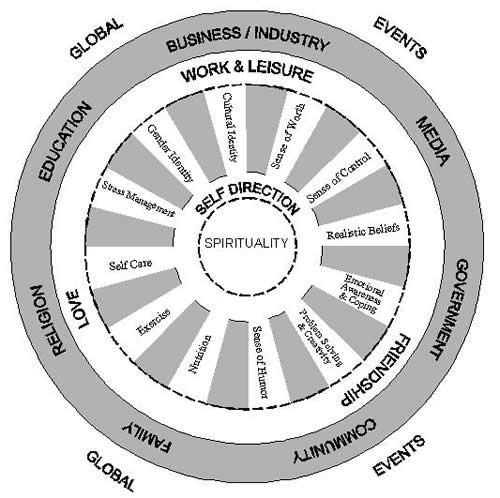
Welcome back to Wellness Wednesday, a fun mid-week look at the areas of wellness in our lives. To remind you, in talking about wellness I'm discussing the positive factors in life that help protect us from the events of life. Wellness is therefore not about the absence of the negative, but the presence of the positive. Remember that I am using the Wheel of Wellness to show the various factors of wellness in our lives.

After introducing the ideas behind work & leisure and looking at an overview of the work factor, today we'll be looking in more detail at the factor of "work" in our lives.

To remind you, here's the definition of the "work" factor of wellness:


Activity that contributes to the well-being of self and others: perception of adequacy of financial resources (financial freedom), job satisfaction, feeling that one’s skills are used, perception of work overload, role conflict, role ambiguity (i.e., psychological job security), participation in decision making (i.e., feeling appreciated), satisfaction with relationships in the job setting


Today I want to look specifically at the phrase "perception of work overload". This is an important issue in our society today, as more and more individuals are being overloaded by work. Here are a few signs and symptoms that you might be headed towards work overload:

  • working increasing hours that are unrealistic or are eating up your time with your family in the evenings
  • unrealistic expectations beyond your job description
  • pressure into working unpaid hours
  • eliminating healthy behaviors from your life in order to work more hours
  • consistently higher and higher levels of stress & frustration
  • Anger
  • Fatigue
  • Dreading going to work
  • Family complaining that you aren't present often, or aren't emotionally present when you're physically present
  • Depression
  • Stomach Pain
  • Migraines
This is obviously a list of only some of the signs and symptoms of work overload, which puts a strain on your body, and will very quickly start decreasing your levels of health and wellness. 

Now it's your turn!
Do you think that you (or someone close to you) have every hit work overload? How does an overload at work influence the other factors of wellness?

Wednesday, February 29, 2012

Wellness Wednesday: {Overview of Work}

First I'd like to say- Happy Leap Year Day! :) I hope you enjoy it since it only comes around once every 4 years.


Welcome back to Wellness Wednesday, a fun mid-week look at the areas of wellness in our lives. To remind you, in talking about wellness I'm discussing the positive factors in life that help protect us from the events of life. Wellness is therefore not about the absence of the negative, but the presence of the positive. Remember that I am using the Wheel of Wellness to show the various factors of wellness in our lives.


After introducing the ideas behind work & leisure last week, today we'll be looking in more detail at the factor of "work" in our lives.

Myers & Sweeney define "work" the following way:

Activity that contributes to the well-being of self and others: perception of adequacy of financial resources (financial freedom), job satisfaction, feeling that one’s skills are used, perception of work overload, role conflict, role ambiguity (i.e., psychological job security), participation in decision making (i.e., feeling appreciated), satisfaction with relationships in the job setting


The continue by saying "People who view their career as a calling tend to experience the highest work satisfaction. Feelings of competence in work tasks also have a positive effect on life satisfaction, and work experiences and work outcomes are consistently and positively related to self-reported emotional well-being" (Myers & Sweeney, 2005, p. 26)*.

Given that we spend a large percentage of our waking hours at work, our jobs can deeply impact our overall health and wellness. Obviously if you are in a place where you are being attacked, intimidated, or simply not supported, this will start to wear on your health. If you aren't in a safe work environment (emotionally, verbally, mentally, physically), this will start to bring down your overall health and wellness, and it is perhaps not the best place for you to be at. Do you have skills that you feel might be used better at your job? Talk to your boss about it! Use your skills in the best way you can, and your work will be more enjoyable and efficient.

Can you develop healthy, supportive, and fun relationships at your job? Sometimes it's hard to enjoy work when others around you are negative, do you have healthy coping skills to deal with it? It's frustrating to feel like we'll be nagged or attacked when we walk into work, but we cannot change those people. All we can do is deal with ourselves, and we still have the power to keep ourselves healthy.

A few questions to get you thinking:

  1. Do you feel like your skills and abilities are being used at the job you are at?
  2. Do you feel supported by your co-workers or boss?
  3. How can you develop healthy coping skills to deal with negative people at your workplace?
  4. Do you have a sense of control over at least some areas of your work?
  5. Is your job well defined? 
  6. If you job isn't well defined, is there a way that you can get a more clear and detailed description of your job, role, and responsibilities?
  7. Are you respected in the workplace?
Now it's your turn!
What skills do you feel are most used in your workplace? What's your favorite thing about your job? What is one healthy way that you deal with the stress of your job? 


*From: Myers & Sweeney (2005). Counseling for Wellness: Theory, Research, and Practice

Wednesday, February 22, 2012

Wellness Wednesday: {Life Task 3: Work & Leisure}

Welcome back to Wellness Wednesday, a mid-week look at various factors of wellness in our lives. Wellness isn't so much about the absence of the negative or illness in our lives, but the presence of positive factors that lead to health in our lives. This takes intentional work and focus, but leads us to a place of being a healthy and flourishing individual. Remember that I am using the Wheel of Wellness to discuss wellness:


I've already discussed Life Task 1 (Spirituality) and Life Task 2 (Self-Direction), and today I'll be moving on to Life Task 3 (Work & Leisure). Today's post will be an introduction, and I will break it down and discuss in more detail in future posts.

Myers & Sweeney define this life task the following way:

Activities and tasks essential to personal well-being and social living, including: work & leisure


How's that for a short and sweet definition? Let's look a bit further at what they meant.

"Work & leisure provide opportunities for pleasurable experiences that are intrinsically satisfying and provide a sense of accomplishment. They challenge or engage our senses, skills, and interests, frequently absorbing us in activities in a state of consciousness called flow (Csikszentmihalyi, 2000). This is an optimal state in which an individual loses awareness of self and time while being highly engaged in the task at hand. Excitement and joy are enhanced while anxiety and boredom are minimized" (Myers & Sweeney, 2005, p. 25-26).

Have you ever experienced "flow" in your work? Have you experienced those moments where you lose track of time and are deeply engaged in what you are doing? This could be either at work (place of employment) or in your hobbies and free time.
A few questions to start asking yourself as we prepare for a deeper discussion on work & leisure:

  1. Is work intrinsically satisfying to you?
  2. Does your work or hobbies you are engaged in provide a sense of accomplishment in your life?
  3. Is there an activity or dream you would like to pursue that you feel would provide a sense of accomplishment, use your skills, or absorb you in that activity?
  4. What keeps you from pursuing those dreams in your work or leisure time? 
  5. How might you be a more healthy individual if work was intrinsically satisfying?
  6. How might you increase those times of "flow" in your life?
Now it's your turn:
What're some of your favorite hobbies? What activities do you get the highest sense of accomplishment from in life? Is there something you would like to pursue but haven't allowed yourself to at this point? What is it? 

Tuesday, February 14, 2012

Love is...

"Love is patient, love is kind. It does not envy, it does not boast, it is not proud. It does not dishonor others, it is not self-seeking, it is not easily angered, it keeps no record of wrongs. Love does not delight in evil but rejoices with the truth. It always protects, always trusts, always hopes, always perseveres. Love never fails...And now these three remain: faith, hope and love. But the greatest of these is love."
~1 Corinthians 13

This passage has always stood out to me. What if we each loved others this way? What if we could let go of our hurried, envious, boastful, proud selves and loved others? Of course we are imperfect people living in an imperfect world, which means that we can't love others perfectly. But we can take steps in our ability to love others (and ourself!) well. 

Last year's post on Valentine's day post may be a helpful read. It discusses Love as a function of wellness. You can see it here

Now it's your turn:
Is there a characteristic of love that is easy for you? What's one of the hardest things (i.e. patience, not easily angered, etc...). Do you have any plans today.

Wednesday, February 8, 2012

Wellness Wednesday: {A Review Of Life Task 2}

Welcome back to Wellness Wednesday, a fun mid-week look at the areas of wellness in our lives. To remind you, in talking about wellness I'm discussing the positive factors in life that help protect us from the events of life. Wellness is therefore not about the absence of the negative, but the presence of the positive. I just finished talking about the 2nd (out of 5) life tasks, and I thought this would be a good time for us to review these components.


Life Task 2 is made up of 12 subtasks:

A few questions to get you thinking:
  1. What is your greatest area of strength? 
  2. How does this strength further your overall wellness?
  3. What are your greatest areas of improvement?
  4. What is one step in each of these areas that you can take to help improve those areas? 
  5. How does your overall wellness in nutrition affect your stress management?
  6. What's one new healthy coping skill that you could implement?
It's interesting to think about how the health in one area of our life affects our health in another (either positively or negatively). It's important to regularly evaluate how each of the areas of our wellness is currently impacting us. 

Now it's your turn!
What are your thoughts on wellness in your life? What areas are easier to be healthy in, and what areas are a little more difficult? 

Wednesday, February 1, 2012

Wellness Wednesday: {Cultural Identity}

Welcome back to Wellness Wednesday! For more information on the Wheel of Wellness, you can check out my wellness page, which includes every past "Wellness Wednesday" post! Remember that wellness isn't the absence of the negative, but the presence of the positive in our lives.
Remember that I'm using the Wheel of Wellness to help visualize health in life:


Alright, after today's post we'll have finally made it through all of Life Task 2 of the Wheel of Wellness. So, today we move on to the final subtask of Life Task 2: Cultural Identity!

Myers & Sweeney define this subtask the following way:

Satisfaction with one’s cultural identity, feeling supported in one’s culture, valuing relationships with people of many cultures, transcendence of cultural identity, competency to cope with stress of cultural identity


When most people start listing dimensions of wellness, this is not one that is often mentioned. However, I think it's an important component of wellness, and once again I'm happy that Myers & Sweeney have included this in the dimensions of Wellness. Myers & Sweeney say the following about cultural identity: "cultural identity incorporates racial identity, acculturation, and an appreciation for the unique aspects of one's culture and is positively related to well-being. It is a positive personal strength that enhances growth and development across the life span" (Myers & Sweeney, 2005, p. 25). Of course our views on most things in life are in some way influenced by our culture as well.

For many Caucasians, it can feel like we don't have a culture, or at least culture the way that some other groups of people experience culture. For those of you who feel that way, here's an idea of how to connect with culture:

  • Determine what countries your ancestors come from. Do a bit of research to figure out what the beliefs, habits, and holidays of those cultures are.
  • Match these values, beliefs, or habits with your own life to see what has trickled down from these cultures. 
  • Is there a way that you can incorporate your country of origin's celebrations into your life here? This can help you gain an appreciation of other cultures, all while gaining knowledge and having fun! 
Once you go looking for it, it's interesting how many things we do that come from other cultures. 

And a few questions to get you thinking:
  1. Are there things you can do to learn more about other cultures and gain an appreciation of them?
  2. How can you increase your knowledge of your own culture?
  3. What can you do to interact with people from other cultures? How can you "get outside yourself"? 
  4. Have you ever felt unappreciated or discriminated against because of your culture?
  5. If you experience stress due to your cultural identity, what steps can you take to keep yourself healthy? 
Now it's your turn:
Do you feel you have a culture? How can you increase your appreciation of both your own culture and of the cultures around you?

* Myers & Sweeney. Counseling For Wellness: Theory, Research, and Practice. (2005). 

Sunday, January 29, 2012

Weekend Wrap Up

Sometimes we just need to smile a bit-

I'm not a morning person at all, so this picture made me smile. 

Here's what you may have missed this past week:
Now it's your turn!
Are you a morning person or a night owl? Did you do anything fun this weekend?

Wednesday, January 25, 2012

Wellness Wednesday: {Gender Identity}

Welcome back to Wellness Wednesday! It might be good to take a moment to refresh your memory about the Wheel of Wellness, and my wellness page includes every past "Wellness Wednesday" post! Remember that wellness isn't the absence of the negative, but the presence of the positive in our lives.


Remember that I'm using the Wheel of Wellness to help visualize health in life:


Today we'll be moving on to our next subtask of Life Task 2: Gender Identity. Only one more subtask for Life Task 2 to go!

Myers & Sweeney define this subtask the following way:

Satisfaction with one’s gender identity, feeling supported in one’s gender, valuing relationships with people of both genders, transcendence of gender identity, competency to cope with stress of gender identity.


This can be a hot topic for people, and I'm glad that this was included in the 17 components of wellness! It obviously goes without saying that if we don't feel valued and accepted for who we are, that will affect our emotions and our health. I also think it goes without saying that we shouldn't belittle someone or make jokes at someone's expense simply because of their gender.

A few questions to get you thinking:

  1. How are you supportive of people in regards to their gender?
  2. Are there any words or actions you use that devalue a person because of their gender? If yes, what can you do to change this?
  3. Do you have friends of both genders? If no, what makes you stick to one and not the other? 
  4. Why are friendships with both genders healthy?
  5. Do you ever experience stress because of your gender? If yes- what are some coping skills you can use to stay healthy? 
  6. How do you embrace your gender identity?
  7. How does health, or a lack of health, impact other components of wellness? 
Now it's your turn:
What are some ways we can show value to each person and help others to feel supported in their gender? What are some ways you see people devaluing others based on their gender? Other thoughts on gender identity? 


Wednesday, January 18, 2012

Wellness Wednesday: {Stress Management Part 3}

Welcome back to Wellness Wednesday! It might be good to take a moment to refresh your memory about the Wheel of Wellness, and my wellness page includes every past "Wellness Wednesday" post! Remember that wellness isn't the absence of the negative, but the presence of the positive in our lives.
Remember that I'm using the Wheel of Wellness to help visualize health in life:


This will be my last post on the subtask of stress management. You can check out part 1 and part 2 here.
Hopefully you are starting to realize that dealing with stress is crucial to your health, and that while it is definitely difficult to deal with at times, it is worth the time and effort.

Here are a few tips for starting to come up with a plan for stress management in your life:

  • Learn to say no and limit yourself: It's easy to overcommit ourselves. It makes us feel important, it helps us avoid having to deal with "real life problems", or it allows us to continue in our people pleasing. Learning to set boundaries and say no will help limit the number of controllable stressors in your life. We need to learn to say no appropriately, and there are limits to what you can give. You may need to say no to things that are good in life in order to not over spend yourself.  (to learn more about boundaries, click here and scroll down to the "boundaries" heading).
  • Establish a regular practice of deep breathing: Deep Breathing will help control your heart rate, blood pressure, and allow your focus and concentration to increase: all necessary things in controlling our stress! I like to set an alarm for a few times during the day to practice. When you notice yourself starting to get stressed, immediately start deep breathing. 
  • Decrease your unhealthy coping skills, and implement healthy coping skills: Check out this post I wrote on healthy coping. Our unhealthy coping skills, while they seem to work initially, actually create more stress in the long run. Practice and implement healthy coping skills to help effectively decrease your stress. 
  • Don't Use Words Too Big For the Subject: In this post I did on using appropriate language, I talked about the possible detrimental ramifications on using words that are too big for the subject at hand. Watch how you talk to yourself when you're stressed. If you're using words like "horrible", "terrible", "completely overwhelming", "unbearable" or other similar words, you're likely to not only increase your feelings of stress dramatically, but you are less likely to function well in the middle of the situation. Use words that are appropriate for the situation. 
  • Engage in Self Care: In the midst of a crazy schedule and stress, the last thing that seems important is taking time to take care of yourself. Check out this post on self care for ways to take care of yourself!
There are a few easy ways to care for yourself and decrease your stress on a regular basis. Come back tomorrow for a post on not playing the victim role to the stress in our lives! 

Now it's your turn:
What's your favorite way to stand up to stress? Why do we use words that are too big for the subject that we are talking about? How can we feel ok about saying no appropriately! 

Wednesday, January 11, 2012

Wellness Wednesday: {Stress Management Part 2- Eustress}

Welcome back to Wellness Wednesday! It might be good to take a moment to refresh your memory about the Wheel of Wellness, and my wellness page includes every past "Wellness Wednesday" post! Remember that wellness isn't the absence of the negative, but the presence of the positive in our lives.


Remember that I'm using the Wheel of Wellness to help visualize health in life:


Today I'm continuing my discussion on the subtask of Stress Management. You can see "part 1" of this subtask here.

I don't think we can have a real discussion on stress management without discussing what "stress" actually means. What IS stress, then? Basically, it's your body's physical and psychological response to anything that you perceive as overwhelming, alarming, or threatening. It's a biological process, with a wide-ranging set of events in the body.

Here's the thing: Not All Stress Is Bad! Sometimes I believe we are trained to think that any and all stress is a bad thing, and we start to panic when we feel stress coming on in our lives. But not all stress is bad, and, in fact, a small amount of stress is actually good for us! Even good stress (i.e. a new job, marriage, or a baby) can become unhealthy and taxing on the body if not properly dealt with.

How is stress good? Here are a few things that stress actually provides for us:

  • initiates invention & problem-solving capabilities and moves us towards creativity
  • It can give us that final push towards making changes or adapting to something
  • It can keep us healthy and happy
  • It pushes us out of our "love affair" with comfort (we can't live within this comfort zone all the time, because we won't change or grow. We become stagnant. Good stress actually helps us be "ok" with getting outside our comfort zone). 
Watch how you react the next time you start feeling a slight amount of stress. Do you panic and freak yourself out? Remember, what we think affects our feelings and our behaviors. The more you say "I'm stressed, I'm so stressed out, I'm overwhelmed", the more you feel overwhelmed and out of control". If you can acknowledge that you are feeling a slight amount of stress and you are choosing to engage with it in a healthy manner, it becomes manageable, and won't take over your life. Does that make sense? 

Here's your challenge: Watch how you talk to yourself when you start feeling stressed? Do you ramp your stress up, or do you acknowledge it for what it is without freaking out?

Now it's your turn:
Do you ramp up your stress level more then it needs to be? How can you use stress for your advantage without letting it overwhelm you?

Wednesday, January 4, 2012

Wellness Wednesday: {Stress Management Part 1- healthy coping}

Welcome to the first Wellness Wednesday post of 2012! It might be good to take a moment to refresh your memory about the Wheel of Wellness, and my wellness page includes every past "Wellness Wednesday" post! Remember that wellness isn't the absence of the negative, but the presence of the positive in our lives.

Remember that I'm using the Wheel of Wellness to help visualize health in life:


Today we will continue discussing Life Task 2 (Self-Direction), and begin discussing the subtask of "Stress Management".

Myers & Sweeney define "Stress Management" the following way:

General perceptions of one’s own self-regulation, seeing change as an opportunity for growth rather than as a threat to one’s security, ongoing self-monitoring and assessment of one’s coping resources, structuring-ability to organize and manage resources (e.g., time, energy, seeing limits, scheduling); need for structure, satisfaction with one’s stress management ability.


Whew! That's quite a mouthful, right? Obviously there's quite a bit involved in stress management, so I'm planning to break this into a few different posts.

Today I'm going to briefly discuss "one's coping resources". A few weeks ago I wrote a post on Healthy Coping Skills that may be helpful for you in determining your own ways of coping. The interesting thing about coping is that it is an activity that can be done before, during, and after the stressful event. Of course this coping will look a little different each time, but it is important to implement this at various stages of stress. Family and Friends play a huge part in healthy coping, as does engagement in faith/religion (social integration is a key in stress management!).

Here are a few questions to ask yourself about how you cope:

  • What things do I naturally go towards to help myself cope with stress (i.e. food, alcohol, TV, music)?
  • Who can I count on in life to help provide coping support when I am stressed and overwhelmed?
  • What aspects of faith and spirituality can help me cope with stressors in my life?
  • What things can I do to cope that are healthy and safe for me?
  • How can I increase my sense of control in this situation to decrease my stress?
  • What things would be helpful to include in my "coping toolbox" so that I'm prepared when stress comes my way?
If you can establish a "coping plan" beforehand, then you'll have something prepared when stress and negative life events happen. Having a plan already created will instantly decrease some of your stress, and will provide you with people, places, and things that will be healthy for you!

Next Wednesday be on the lookout for Part 2 of the "Stress Management" subtask!

Now it's your turn:
What sorts of people, places, and things might be helpful for you to put in your "coping toolbox" so you're prepared for the stressful moments in life? Are there negative ways you cope that you would like to decrease?

Wednesday, December 14, 2011

Wellness Wednesday: {Self Care Part 2}

Welcome back to "Wellness Wednesday", a midweek look at one aspect of our health and wellness in life. Remember that I'm using the Wheel of Wellness to help visualize health in life:


If you need a little refresher, click here. We are currently in the middle of Life Task 2: Self Direction, and today we will be continuing our discussion on Self Care. This is an excellent time of the year to be focusing on self care, as any time holidays or family gatherings hit, it's easy to give up our self care activities. 


Myers & Sweeney (in their book Counseling For Wellness) have outlined 3 aspects of self care within this dimension of health:
"safety habits that we learn to protect ourselves from injury or death; periodic physical, medical, and dental checkups; and avoiding harmful substances, both those that we might ingest and toxic substances in the environment" (p. 24). 
The goal of self-care, then is to increase longevity of life, and to be as healthy as possible while living that life. 


Here are a few behaviors that fall under the category of "self-care"

  • Brushing & flossing teeth on a daily basis
  • Avoiding prolonged exposure to the sun, using sunscreen, and avoiding tanning beds (PLEASE!)
  • Wearing a helmet while riding a bike... always... 
  • Learning how to tread water and swim (in order to stay safe near the water)
  • Wearing a life jacket while out on a boat
  • Not diving in lakes/ponds/shallow pools
  • ALWAYS wearing a seat belt in the car
  • Getting appropriate vaccinations
  • Checking the back seat of the car before getting into it
  • Looking both ways before crossing the street
  • Not texting while driving (please don't text... seriously.... it's really dangerous)
  • Having a designated driver if you go out and drink
  • Avoid smoking
  • Eat a healthy and balanced diet 
  • Limit the number of alcoholic beverages you drink on a regular basis
  • Lock your house while you're home & when you're gone, EVEN IF you live in a safe neighborhood. 
These are just a few things to help get you thinking about the self care measures that you currently take in life, and which areas might need improvement. Modeling and teaching appropriate self care and safety to our children is important, as children tend to do what they see their parents do. 

Now it's your turn:
What important aspects of self-care do you regularly do? Which aspects of self-care might you need to improve? Do you regularly schedule appropriate health screenings and check-ups? 

Wednesday, December 7, 2011

Wellness Wednesday: {Self Care Part 1}

Welcome back to "Wellness Wednesday", a midweek look at one aspect of our health and wellness in life. Remember that I'm using the Wheel of Wellness to help visualize health in life:


If you need a little refresher, click here. We are currently in the middle of Life Task 2: Self Direction, and today we will moving on to another subtask, Self Care. This is an excellent time of the year to be focusing on self care, as any time holidays or family gatherings hit, it's easy to give up our self care activities. 


Of course "self care" can include more things then we actually think. Myers & Sweeney define this subtask the following way:

Not abusing substances, using seat belts, getting adequate sleep, obtaining preventive medical and dental care.


How many of you, while sitting in the dentist's chair, think "I'm engaging in self care right now!" Hm. Probably not. 


Before I get started on discussing some different aspects of this subtask of wellness, I thought I'd share some links to previous posts I've done on self-care (just to get you thinking!).
10 Ideas To Refill Yourself
Loving Myself, Loving Others
Boundaries & Burnout
Boundaries & Burunout {Part 2}


When we don't take care of ourselves, we run the risk of burning out. That's why I think a discussion on boundaries & burnout is crucial in understanding why self care is so crucial. Make sure to check out some of the above posts, and I'll be back next week with a continuing discussion on self care!


Now it's your turn:
Have you ever been close to burning out? How do you view self care?

Wednesday, November 30, 2011

Wellness Wednesday: {Exercise Part 3}

Welcome back to "Wellness Wednesday", a midweek look at one aspect of our health and wellness in life. Remember that I'm using the Wheel of Wellness to help visualize health in life:


If you need a little refresher, click here. We are currently in the middle of Life Task 2: Self Direction, and today we will continue to discuss the subtask of Exercise (you can see "part 1" of exercise here, and "part 2" of exercise here).
Last week I outlined some tips for success in developing a plan! These tips can help you be successful in staying healthy not only through the holiday season, but throughout the year as well. 


Today I want to pass along a few websites that are helpful when creating a fitness plan, and establishing a well rounded fitness routine.

Best Body Fitness : Tina has a great balance of health, nutrition, and fitness in her life. Her site includes a number of great fitness routines and reviews of various DVDs. She's an excellent resource!
Mayo Clinic: Fitness training: Elements of a well-rounded routine : This is a great article that breaks down the types of exercise and training needed to be healthy overall. I highly suggest reading it!
Stretching: Focus on Flexibility: This article goes in depth with information on stretching. At the bottom of the article are more links to various stretches, etc...
RealAge - This site has a variety of different programs and health information that is free! They have some great walking videos

Remember that exercise and well rounded fitness isn't JUST about cardio or JUST about strength training. It's about a balance of a number of components. I hope these links are helpful in identifying things you can do in each area of fitness to increase your overall fitness in life!

Now it's your turn:
What are your favorite fitness websites? How do you plan to stay fit during the holidays?