Showing posts with label Perfectionism. Show all posts

Wednesday, March 21, 2012

Striving For Excellence, Not Perfection

It's Quote Week here on the blog, and I hope you've been enjoying reading some of my favorite quotes.

"Striving for excellence motivates you; striving for perfection is demoralizing."
-Harriet Braiker

About a year ago I did a series on perfectionism. Perfectionism robs us of that which is excellent. Striving for perfectionism can drive us mad because we cannot be perfect. We are not perfect people. We can be people of great excellence, but we won't be perfect. Are you able to let go of the striving for perfection in order to grab hold of that which is great and excellent?

For more information on perfectionism, check out the following posts:


Friday, January 13, 2012

Friday Favorites

Favorite Tiny Delight of the Week
Hummus! I can't remember if I've ever chosen a food as a tiny delight of the week or not, but it's certainly not something I do often. This is a great "tie me over" snack when i get home from work. I keep some cut up veggies in my refrigerator, and it's an easy snack when I have the munchies! 

Favorite Quote of the Week
"Shall we make a new rule of life from tonight? Always try to be a little kinder than necessary." -J.M. Barrie

Favorite Post By Someone Else
What Do School Counselors Do Anyways? - Ali at Food. Fitness. Fashion shares what responsibilities make up her job as a school counselor. This post is easy to read and will give you a good idea about one aspect of the field of counseling! 

Favorite Past Post
Hello, I'm--- and I'm a Perfectionist - This post is from about 10 months ago, but in the last week has gotten more views then it did when I originally posted it. I'm not sure why though! So, I decided to just post it here and let you all take a look. Enjoy!

Favorite Search Term

Now it's your turn:
What're some of your "favorite things" from the week? 

Friday, December 23, 2011

Friday Favorites

Favorite Tiny Delight of the Week
Working out with my family! One of my family traditions is to work out every day together once we all get to my parents house for Christmas. We've been going to the gym every day, and spinning, doing yoga, pilates, and weight-lifting together. Not only do we get in some quality time together, but we also stay healthy! It's a great time of fun, laughter, and sweating, and it's good to see each family member choosing to be healthy!

Favorite Quote of the Week
"It is Christmas every time you let God love others through you... yes, it is Christmas every time you smile at your brother and offer him your hand." -Mother Teresa

While this is the season of gift giving, I'm wondering if you can think of some "gift of love" that you can give 
others this season.

Favorite Post By Someone Else
Time In The Dark - An excellent post on the shortest day of the year, and how it can remind us of important things in life. Check it out!

Favorite Past Post
Thoughts Of A Perfectionist - I included this post this week because during the holiday season, people tend to stress about doing things the "perfect" way or have high expectations of themselves of others. Check this post out, and develop realistic expectations for yourself! 

Favorite Search Term
This post is short & sweet today. I know that, with these last few days before Christmas comes a lot of busy and hectic schedules. Enjoy time with your family & friends as you do your final preparations for Christmas. I know I'll be spending my day shopping & wrapping!

Now it's your turn!
What're some of your "favorites" for the week? What's a "gift of love" you can give to another person this Christmas season?

    Tuesday, December 6, 2011

    Tips For Reducing Stress During the Holidays {Part 1}

    Oh, for the good old days when people would stop Christmas shopping when they ran out of money.  ~Author Unknown

    Last year I did a post on Tip for Surviving the Holidays with Family. I think many of these tips are applicable in each of your lives (unless your family is, in fact, perfect!), so make sure to check them out!

    Stress levels can easily sky-rocket during the holiday season, which can place further distress on our relationships. Today I want to pass along a few tips for reducing stress during the holidays.
    • Prioritize Your Activities! There are so many great activities this time of year in which to participate. Christmas movies, Christmas concerts, parties, gift exchanges, caroling, cooking decorating parties: you name it, it exists and you've probably been invited to it. You can't do everything, so prioritize and say "no" to those activities that don't make the cut. For the people pleaser, this is difficult, but remember that YOUR HEALTH is important (if you are a people pleaser, click here and scroll down to the "boundaries" category).
    • Make Sure To Take Your "Me" Time: While this is a good season to look outside ourselves, give to others, and celebrate with one another, it's important to get a few minutes every day for self care. The ability to recharge ourselves helps create a buffer against holiday stress, and increases our patience towards those around us. 
    • Maintain healthy habits: During holidays it's easy to give up exercise, healthy eating, and sleep. Doing that will certainly make you feel worse both physically and emotionally. Make sure to continue your healthy habits as much as possible, and remember that balance is important!
    • Set a budget for yourself: Our stress can increase if we dig ourselves into a financial mess. Be wise with your spending, and make sure you are careful on how you spend. If you are lonely or feeling "low" emotionally, there can be a temptation to buy "stuff" in order to cope. It might help in the moment, but will not actually help the situation, and put you in a bigger mess when it comes time to pay the bills. This can be a HUGE stressor for months following Christmas, so make this "tip" a priority. (This is also why I started this post with the quote above).
    • Release the expectation of a "perfect" holiday: Most of us imagine the holiday in a certain way. Even if it isn't "perfect", this imagination tends to become our expectation of what the holiday will be. To be healthy, it is important to let go of expectations for the "perfect" meal, the "perfect" gifts for families, the "perfect" decorations for the house, etc... Do your best, but don't kill yourself over trying to make everything about the holiday perfect. You (or your children) will more then likely remember how stressful it was over how fun it was. 
    *Part 2 of this post will be coming later this week!

    Now it's your turn:
    How do you work on reducing the stress in any of the areas listed above? 

    Wednesday, August 3, 2011

    Wellness Wednesday: {Sense of Worth}

    Happy Wellness Wednesday! For myself personally, I love doing these Wednesday posts, as they are a good check and reminder for myself as well. If you've missed any of the posts, here are the previous posts for Wellness Wednesday:

    Wellness Wednesday: {An Introduction}
    Wellness Wednesday: {An Introduction pt. 2}
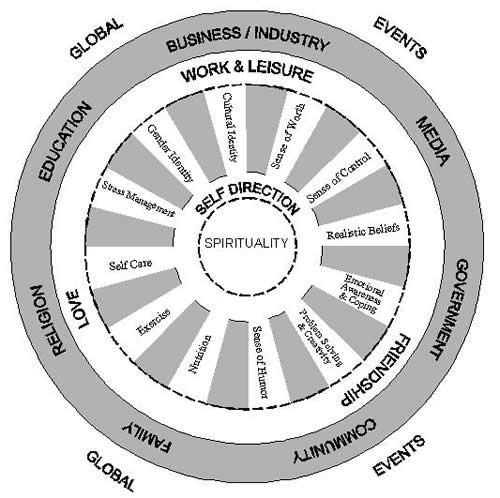
    Wellness Wednesday: {The Wheel of Wellness Part 1}
    Wellness Wednesday: {The Wheel of Wellness Part 2}
    Wellness Wednesday: {Life Task 1: Spirituality}
    Wellness Wednesday: {Life Task 2: Self Direction}

    For those of you who have read some of the posts, you might recall that I'm using the idea of the Wheel of Wellness to visually represent wellness for the individual.


    Last week I introduced the second life task, which is Self Direction. Within the second life task there are 12 subtasks. Right now I'm planning to start at the top and work my way around the circle clock wise. 
    Today, I'm discussing the first subtask: Sense of Worth.

    Myers, Sweeney, and Witmer define this subtask the following way:


    Satisfaction with self, acceptance of self with one’s imperfections, acceptance of one’s physical appearance, valuing oneself as a unique, worthwhile person.


    The term sense of worth could also be interchanged here with "self esteem". 

    When I think of self-esteem I naturally think "can you be ok with you and love yourself for who you are?" I believe that's what self esteem boils down to. Unfortunately, there are a lot of things that chip away at our self-esteem: being bullied, harsh or abusive words and actions by a family member, or unrealistic expectations of self to name a few. We can easily become a mangled piece of who we originally were, and it can take a lot of energy and strength to remain strong in who we are in the hot fire of the world. 

    I've been a lot of posts throughout this blog on various things that help to increase ones sense of worth in life. Here are some of the links:

    Boundaries: Establishing healthy boundaries helps define what is me, and what is not me, what is my responsibility, and what things are the responsibility of others. A lack of boundaries can lead to a confusion of one's identity, so to have a strong sense of worth, healthy boundaries are important to implement. (Click here to find the boundaries category of posts)

    Cognitive Distortions: When we distort ourselves, the world around us, or even others in our life, we can easily confuse things. These distortions can distort our identity and sense of self. To have a healthy sense of worth, it's important to try to decrease the cognitive distortions used in every day life. (Click here to find the cognitive distortions category of posts)

    Perfectionism: As the definition above says, sense of worth involves acceptance of one's imperfections. If a person holds to perfectionistic standards, they will constantly be a failure to one's self, which obviously will decrease a sense of worth. (Click here to find the perfectionism category of posts)

    Affirmations: Awhile back I wrote about using affirmations as a way to increase self esteem. I've seen this help a large number of clients, and believe that this is a very helpful component. You can click here to read about it!

    Accepting Your Physical Appearance: I wrote a post on developing a healthy body image, which is part of having a healthy sense of worth. You can click to read it here.

    Each of these posts that I've linked to includes steps that you can take to help with your journey. Remember that health is a never ending process, so give yourself time to work on changes! Self esteem doesn't happen overnight!

    What is one thing that helps you have a strong sense of worth in life?
    What makes you a unique, individual person?

    Friday, July 1, 2011

    Fantastic Fridays (Life's Tiny Delights)

    Enjoy the little things, for one day you may look back and realize they were the big things.

    -Robert Brault

    I have to admit that I REALLY look forward to my Friday posts all week. It's not because I think they're amazing or anything like that, but because it's starting to change how I view my entire week! And that's the goal, isn't it? To get the background on my Friday posts, you can click here.

    With the start of spring, my tiny delight for the week has been: SUNSHINE! After a long week of rain, it was nice to feel the sun beating down on me once again (and catch a few days at the pool). I sometimes get so focused on my life and responsibilities that I miss what's going on around me. So this week, it was all about focusing on the sunshine. Here are a few pictures I snapped throughout the week:


    Pretty, isn't it? I definitely don't feel like I get enough days of sun a year, but this week instead of grumbling about that fact, I chose to be happy for the time I did have to see the sun!

    And for a little Friday Fun, here are some of the searches people did to find my blog:
    • how to deal with catastrophizing
    • chobani for my diet/chobani for lactose intolerance (this seems to get lots of hits a week...)
    • identity perfectionism
    • morning oatmeal with chocolate and peanut butter (i hope this person tried it and Loved it!)
    • counseling encyclopedia- cognitive distortion
    Have a great start to the weekend, and enjoy the sunshine:)

    What I'd like to know:
    Do you prefer sunny or overcast days?
    Do you have any fun plans for this holiday weekend?


    Friday, March 18, 2011

    Thoughts Of A Perfectionist

    Alright, jumping around just a little bit (it keeps you on your toes!), I'm going to go back to perfectionism for today. Sometimes when we get too much information right up front, we don't have time to really think about what we're reading and figure out how it plays out in life. If you haven't read the rest of my posts on perfectionism, here are the links:


    Before we go about changing our perfectionistic thinking, we obviously need to learn how to identify when we are having these thoughts. Without awareness, we can't begin to change. I challenge you to think of your "rules" and expectations for yourself and others in multiple areas of your life. Don't choose just one area, like work or family, but try to choose many (chores, work, family, cooking, yard/house maintenance, appearance, relationships, etc...). Perfectionism tends to touch more then one area of life because it can often distort our identity (check out the link above!).

    So here are a few examples:

    • I should contact my roommate from college every week (and when I don't, then I'm a bad friend)
    • I must keep my kitchen spotless and not ever stack dishes in the sink
    • I need to get a ___% (100, 99, etc...) on every test to be a good student. Any less then this and I'm a slacker, bad student, or failure.
    • If I can't do the job perfectly, I'm not even going to try, because I don't want to look incompetent
    • This person needs to be nice to me by doing ____, ____, and ____ every day, or I can't believe that they really care.
    • I must check every paper I write 10 times to make sure that I don't have a single spelling or grammatical error. If I miss something, the professor will think I'm stupid and incompetent, and will judge me every time they see me.
    • I need to be a starter in every single sports game for my parent to really love me or care about me.
    • (upon receiving a B on a test) I should have studied more and not spent time with my roommate a few nights ago. If I would have isolated myself so I could study more, I might have gotten a higher score.
    • (upon not being chosen for something you applied for)- I shouldn't have even tried. I never get what I apply for and only feel embarrassed- I'm a failure.
    Ok, so like I said, these are just a few examples to get you started. Each person is going to have there own beliefs, depending on personality, environment, and others.

    Have you heard others around you make statements similar to these? More importantly, do you ever say these types of statements? What're the results? 

    Monday, March 14, 2011

    The Development of Perfectionism {Part 2}

    I took a break in my series on perfectionism to talk about why I wasn't complaining. If you haven't checked it out yet, you can read it here . While you're at it, if you haven't read Part 1 of the Development of Perfectionism yet, check it out here before going on...then come back here:) So, in the last post on perfectionism, I introduced the idea of the development of perfectionism, I discussed a little about social learning, and the expectations and standards of others.

    In Elliot &Hewitt's 2002 book entitled Perfectionism: Theory, Research, and Treatment, they discussed the family environment of perfectionism. Here are some of the things they discovered in the connection between family characteristics and perfectionism:


    • Maternal rejection or shaming behavior
    • Low levels of maternal tolerance and affection
    • Higher levels of parental overprotection & control
    • Shame by those around the person
    • Poor health in the family of origin
    • Low parental care
    • Parental control & perfectionism was also indicated in the development of eating disorders
    These characteristics tend to lead to self-oriented perfectionism, instead of some of the characteristics from yesterday, which lead to more others-oriented perfectionism. There are also personal characteristics of the child that tend to lead to implementing more perfectionistic standards in life. These include:
    • Temperament (aspects of a person's personality that are innate, like introversion or extroversion) 
      • "We believe that perfectionists have a temperament that is characterized by high levels of emotionality, including high fearfulness, along with high levels of persistence" (Elliot & Hewitt, 2002, p. 111). 
    • Attachment Style (the way you interact with others in more intimate relationships)
    • Ability of the child to be influenced by those around him or her
    • Personal definitions of success & failure
    • Distorted thinking
    • People Pleaser
    It's important to remember that perfectionism doesn't generally develop solely because of one factor. There's usually some mixture of environmental, parental, & personal factors that lead to holding perfectionistic standards in life. Knowing the "why" of perfectionism doesn't necessarily help to change it (you can spend hours in therapy trying to figure out why you are thinking the way you do, or you can spend a little time discussing it, and then dive into challenging and changing those standards), but sometimes it helps us understand that we aren't "just nuts" like we sometimes can believe. 

    Ok, this was a very brief, tip of the iceberg, explanation on how perfectionism can develop. Understanding this can help give us some answers to why we are the way that we are, and it can help to inform our behaviors when we raise children of our own. Knowing all of this, we need to start changing how we think and what our standards are, so that we don't remain stuck in the trap of perfectionism.

    *you can find the rest of the posts in my series on perfectionism here.

    If you struggle with perfectionistic tendencies, can you see anything that might contribute to the development of it in your life? Are you ready to start challenging your thinking?

    Saturday, March 12, 2011

    The Development of Perfectionism {Part 1}

    When discussing Perfectionism with clients, I usually ask them something like "What do you think started this pattern of beliefs and expectations in your life." Of course I'm not expecting them to always know the reason why, but it's interesting to hear the brainstorming that occurs. Some people talk for a few minutes with a lot of "i don't knows" thrown in, while others immediately can list a series of expectations put on them by parents that they believe have led to the perfectionism in their life.

    Perfectionism can't always be pinpointed to one person or one moment in time. It can be complex, with a number of factors, experiences, and people involved. One of the prominent ways people seem to develop perfectionism is through other-imposed standards and expectations.

    A child learns that by following the expectations and standards of those around her, she is able to avoid an argument, beating, or "make the parent happy" when she is perfect (or perfectly meets the expectations). "Implicit in the social expectations model is the notion that children who are not capable of meeting parental expectations will experience a chronic sense of helplessness and hopelessness as a result of their inability to meet the standards imposed on them...a sense of contingent self-worth is a central aspect of socially prescribed perfectionism" (Elliot & Hewitt, 2002, p. 90). Parents, or others close to us in life, can create a way of life where our self-worth is contingent on our achievement or looks. In this sort of system, we quickly learn that when we fail to achieve, we don't have worth and aren't "ok". Not only are we "not ok", but depression, anxiety, and stress, along with feeling unloved, can result.

    Social learning basically suggests that we learn in a social context, through the words and actions (the modeling) of those around us. Even if parents don't put perfectionistic expectations on their children, they can model the "importance" of perfectionistic standards to their children in how they speak about themselves. Children tend to think and speak like their parents do, and when it comes to things that are unhealthy, this modeling is obviously a little dangerous.

    Also, interestingly enough, "perfectionism was associated with guilt, psychological distress, and a maladjusted family of origin...correlations that reflected a lack of intimacy and autonomy" (Elliot & Hewitt, 2002, p. 97). I found that interesting. The more controlling and stifling the family is, the more likely perfectionism will develop.

    *you can find the rest of my series on perfectionism here.

    I will leave it at that for the day.
    So what do you think? Did your own family of origin lead to perfectionistic standards in your own life? 


    Elliot, G.L., & Hewitt, P.L. (2002). Perfectionism: Theory, Research, and Treatment. american psychological association. 

    Friday, March 11, 2011

    The Best Laid Plans... {And randomness from the week}

    Do you ever have those nights (or weeks) that are full of good intentions and plans, and yet when the time comes, everything changes and nothing planned actually happens? Well, that's how most of this week has been for me. Last night, for example, I actually got out of work at around 5:15, and had nothing on the schedule for the evening. And, you may call me a nerd, I was excited to use my free evening to read up on some of the latest research on perfectionism. However, with a long series of phone calls that came in one after the next, and a friend in need, it was soon 10 o'clock and I had done nothing. Well, at least nothing that I had planned. But sometimes things pop up that we don't plan, and we have to be flexible and adjust. 

    Tonight I will be writing the next few posts of my perfectionism series. If you have any questions about it, I'll do my best to answer. In the meantime, why not read up on the posts in the series so far?
    I'd be remiss to skip over the devastation that occurred in Japan today. Words don't really seem so appropriate for the magnitude of what occurred...I'm sending my thoughts and prayers to those there, and for family & friends of those living in Japan. 

    Despite the fact that there's been a lot of stress and unrest in many parts of the world the last few weeks, my day was rather calm and peaceful. I'll leave you for the night with a few pictures from my day:

    My day started with a free Earl Gray Tea latte on my way to work 

    Then a friend stopped by work to give me some flowers. So pretty & spring-ish! 

    Then, driving home, I saw this beautiful scene. LOVE it.

    Despite the pain & devastation going on, did you have good moments in the day? 

    Sunday, March 6, 2011

    Perfectionism & The Distortion of Identity

    -Anna Quindlen

    I've always been surprised at how tightly perfectionism and identity/self-esteem are tied together. When a Client says they struggle in one area, I automatically ask about the other area as well. Most of the time, I'm spot on (and they seem to be surprised at the quick connections I make) and they do, indeed, struggle with both. I get it because at one point I was there myself. In high school I had extremely rigid, perfectionistic standards for myself, yet I felt terrible about myself. It was as I began to challenge and loosen these standards and rules for my life that the distorted mirror I saw myself in began to become more and more clear. It was through this that I began to figure myself out, and feel good about the person I was (and am). 

    Perfectionism isn't realistic, and it distorts the way we see the world (remember yesterday's post on black/white thinking about how we need shades of gray to see the entire picture). It distorts our needs & wants, our identity, our self-statements and beliefs, and our relationships. All of this combined leads to a distortion of how we live within the world, and how we feel about ourselves as we go about daily life. Perfectionism tends to say that I am a failure (unless I'm 100% perfect in everything then I'm a failure), and when we are constantly "failing" we will obviously feel really bad about ourselves. This type of thinking is detrimental to us, and quite honestly, not fair to ourselves either. 

    I found a website that listed some reasons that perfectionism lowers self-esteem:
    1. Fear of failure is among of the reasons for perfectionism. Often times, perfectionists blame their failures to lack of personal worth.
    2. Another reason is being afraid to make mistakes. For perfectionists, mistakes and failure are the same. They miss opportunities to learn and grow by living their lives avoiding mistakes.
    3. Fear of rejection is a one of the most common reasons. Perfectionists are often afraid that if other people see their flaws, they will be rejected.
    4. Rigid Rules. Perfectionists live with rigid rules structured by a never-ending list of “should”.


    If you do just one thing for yourself this week, give yourself a break and try to start identifying how perfection & your identity are tied together. Be fair to yourself and loosen the grip you have on perfectionism.


    *you can find the rest of my series on perfectionism here.

    What I'd like to know:
    Did you do anything fun this weekend? Any steps to furthering your health and wellness? Have you seen perfectionism distort your self-esteem or identity?

    Saturday, March 5, 2011

    Black & White Thoughts of a Perfectionist

    Is this purely black and white, or are there shades of gray?

    In yesterday's post, I introduced the concept of Perfectionism. One of the "foundational pillars" behind the ideas and beliefs of perfectionism is black and white (also called all or nothing) thinking. For example, either I'm ALWAYS perfect, or I'm NEVER perfect (and therefore ALWAYS a failure). 
    Although we hear the phrase "black and white thinking" often, I think it can be helpful to have something visual to help understand why black and white thinking is inaccurate and unhelpful. So, look above at the picture. What do you notice about it? What do you see in the picture? Ok, after you've done that, take away everything from that picture that isn't 100% black or 100% white (so, basically remove everything that is a shade of gray). Now what's left?
    There is very little left to this picture if you take away the shades of gray. There may be a few lines here and there, but we won't get an accurate idea of what the picture actually is. The beauty and story is distorted.  
    When we use black/white thinking, we are engaging in a cognitive distortion, or an irrational belief. Sometimes we feel like our story will be more dramatic and colorful if we use these types of words too. But taking away shades of gray distorts the picture, and shows us a view of the world that isn't real. And although we sometimes feel that using a shade of gray word is boring (for example, instead of sweltering or freezing, we may just say warm or a little chilly), but in reality, we need the shades of gray to see the details and the reality in the world. That picture is beautiful too.

    So the next time you are tempted to think in black and white terms, go back to this picture. Or better yet, hang a black and white picture on the mirror in your bathroom, or on your desk at work, and when you're tempted to think in black and white terms (or engage in one your standards of perfectionism), look at the picture and challenge yourself! 

    * you can see the rest of my series on perfectionism here.

    How does black and white thinking play a part in your life? Do you use any visuals to help you remember things or challenge your thinking? 

    Friday, March 4, 2011

    Hello, I'm ____ and I'm A Perfectionist...

    Perfection, fortunately, is not the only alternative to mediocrity. A more sensible alternative is excellence. Striving for excellence is stimulating and rewarding; striving for perfection--in practically anything--is both neurotic and futile.
    -Edwin Bliss

    The pursuit of perfection often impedes improvement.
    -George Will

    "Hi, I'm ____, and I'm a perfectionist." How many of us could put our name on the line? I'll admit it-I'm a recovering perfectionist. I've spent many years challenging the thinking, expectations, and standards that kept me trapped in the perfectionist struggle for years. Another thing I'll admit-I'm NOT perfect (*gasp*) at staying away from perfectionist standards 100% of the time. That's right. I'm not perfect at not trying to be a perfectionist.

    Before we can start to challenge and change some of the beliefs and expectations behind perfectionism, I think it's important to understand what is involved in this process.  So, how about a little education & discussion on perfectionism, and then moving on to the challenge (you all know how much I love challenging our automatic thoughts!)?

    1. Perfectionists CAN be Procrastinators. This seems like the opposite would be true. For example, the idea that perfectionists finish everything way before they need to have it done. This may certainly be the case, but perfectionists can also be procrastinators (and people who define themselves as a procrastinator may, without realizing it, be a perfectionist!). With perfectionism there is such a fear of failure (of not meeting the unrealistic expectations that have been set), and this fear becomes paralyzing.
    2. Perfectionism is a Losing Game! No matter how hard you try, you won't be perfect. Realistically, we can say that. We are imperfect people living in an imperfect world. However, we trap ourselves in a series of lies that tell us that if we only do x,y,and z, we will be perfect. And within the "rules" of perfectionism game, unless we are perfect, we are a failure. Therefore, perfectionism is a losing game (even if we can occasionally delude ourselves into believing that we can win at the game).
    3. More then likely, you will actually be more successful if you strive for doing well instead of strive to be perfect. We tend to believe the myth that if we release our tight grip on our standards and strict rules for living, that we will quickly slide back into being unsuccessful, getting bad grades, or failing at our relationships. However, when we can let go of some of that fear and control, we tend to stay motivated in a healthy way, and can engage more fully in what we're doing (both work AND in relationships!).

    So, my perfectionism says that I want to be incredibly thorough in giving information. However, I know that I tend to start skimming long posts instead of actually reading and thinking about them, and I want to watch a little TV on this Friday night. So, I will keep this post as is, and continue the discussion of perfectionism tomorrow:)

    *you can find the rest of my series on perfectionism here.

    Here's what I'd like to know from you:
    Do you struggle with perfectionism? What are some of the unrealistic beliefs about perfectionism that you have seen or experienced?And finally: Any fun plans for the weekend?